

Imagine you’re a patient who just completed a groundbreaking treatment, but your doctor only asks about lab results and not how you actually feel or whether you can return to daily activities. This disconnect between clinical data and real-time patient experiences is exactly why clinical outcome assessment has become a game-changer in modern healthcare.
In FDA labels, the inclusion of nonmandatory COA increased from 18.6% to 28.4%. These powerful tools bridge the gap between what doctors measure and what patients actually experience.
The Patient-Centered Revolution: Why COAs Matter More Than Ever
Clinical outcome assessment represents a fundamental shift in healthcare philosophy from treating diseases to treating people. While traditional medical metrics focus on biological markers and clinical measurements, COAs capture what truly matters to patients: their symptoms, daily functioning, and quality of life. This patient-centered approach has gained unprecedented momentum as healthcare systems worldwide recognize that successful treatment isn’t just about improving lab values, it’s about helping patients live better lives.
The growing emphasis on COAs reflects a broader transformation in healthcare delivery, where patient insights and voices are no longer secondary considerations but primary drivers of treatment decisions. Regulatory bodies, healthcare providers, and pharmaceutical companies are increasingly mandating COA integration, making these assessments essential for anyone involved in patient care, clinical research, or healthcare innovation. This evolution hasn’t happened in isolation, and it’s also been fueled by patient advocacy movements, regulatory reforms, and mounting evidence that traditional clinical measures often miss the most important aspects of patient well-being.
1. Captures the Complete Patient Experience Beyond Clinical Numbers
COAs reveal the human story behind medical data by measuring symptoms, functional abilities, and quality of life that traditional clinical measures often overlook. While blood tests show biological changes, COAs show whether patients can work, sleep, or enjoy relationships and the outcomes that truly define treatment success. This comprehensive view helps healthcare providers understand the full impact of treatments on patients’ lives.
2. Drives Regulatory Approval for Life-Changing Treatments
The FDA and EMA now require COA data for most drug approvals, recognizing that regulatory decisions must reflect patient benefit, not just biological activity. This requirement has transformed pharmaceutical development, ensuring new treatments demonstrate meaningful improvements in patients’ lived experiences rather than just statistical significance in clinical markers. COA assessment methods now play a crucial role in bringing therapies to market.
3. Enables Personalized Treatment Plans That Actually Work
COAs provide the granular patient feedback necessary for truly personalized medicine, allowing healthcare providers to tailor treatments based on individual patient responses and preferences. This data-driven personalization goes beyond one-size-fits-all protocols to create treatment approaches that align with each patient’s unique circumstances and goals. Providers can adjust medications, therapies, and interventions based on real patient feedback.
4. Transforms Clinical Trial Design to Focus on Real-World Impact
Modern clinical trials increasingly use COAs as primary endpoints, shifting focus from surrogate markers to outcomes that matter in patients’ daily lives. Of the 476 FDA labels reviewed, 116 (24.4%) mentioned at least 1 nonmandatory COA. This transformation ensures that research investments generate treatments that provide tangible benefits, not just impressive laboratory results that don’t translate to improved patient experiences.
5. Supports Value-Based Healthcare Payment Models
Healthcare systems are transitioning to payment models that reward patient outcomes rather than service volume, making COAs essential for demonstrating treatment value. Nonmandatory COA inclusions in HTAs increased from 45.2% to 64.9%. These assessments provide the evidence needed to link reimbursement to actual patient benefit, aligning financial incentives with quality care delivery across different healthcare systems.
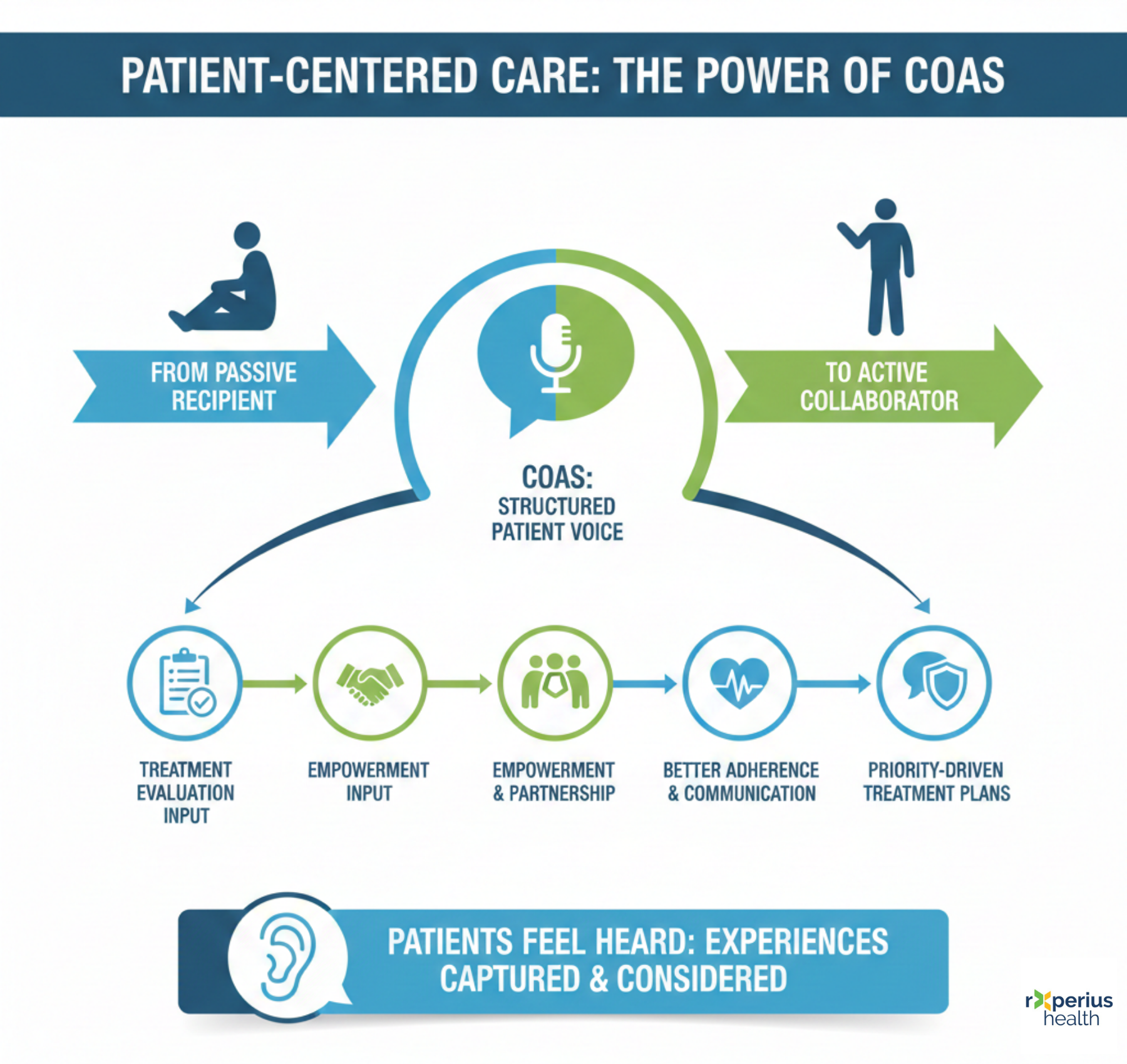
6. Empowers Patients as Active Participants in Their Care
7. Accelerates Digital Health Innovation and Remote Monitoring
The integration of COAs with digital platforms enables continuous, real-time assessment of patient status, supporting telehealth expansion and remote patient monitoring programs. ICON’s patient-centred outcomes expertise spans four decades of innovation and research on directly engaging with patients across the entire healthcare landscape and through the entire treatment lifecycle. These technological advances make healthcare more accessible while providing richer data for treatment optimization.
8. Bridges the Gap Between Clinical Research and Real-World Practice
COAs ensure that clinical trial results translate meaningfully to real-world patient care by measuring outcomes that reflect actual treatment experiences in diverse populations. HTAs were generally more likely to report nonmandatory COAs in comparison with FDA label indications (https://www.sciencedirect.com/science/article/pii/S1098301525023617). This bridge prevents the disconnect between promising research findings and disappointing real-world implementation, ensuring treatments work outside controlled environments.
9. Enhances Drug Safety Monitoring Through Patient-Reported Side Effects
Patient-reported COAs often detect safety issues and side effects that clinical assessments miss, providing early warning systems for treatment modifications. COA measures can capture subtle changes in quality of life or functional status that might indicate emerging problems before they become serious complications. This enhanced safety monitoring protects patients while helping healthcare providers make more informed risk-benefit decisions.
10. Drives Healthcare Quality Improvement Through Systematic Feedback
COAs provide systematic, standardized feedback that enables healthcare organizations to identify improvement opportunities and track progress over time. This continuous quality improvement approach helps providers deliver better care while building evidence for best practices. When asking what are clinical outcomes, COAs offer concrete answers that guide organizational learning and development across healthcare systems.
COA Implementation Across Healthcare Settings
|
Setting |
Primary COA Use |
Key Benefits |
Common Challenges |
|
Clinical Trials |
Regulatory endpoints |
Patient-centered data for approval |
Cost and complexity |
|
Hospital Care |
Quality monitoring |
Real-time patient feedback |
Staff training needs |
|
Outpatient Clinics |
Treatment tracking |
Personalized care plans |
Technology integration |
|
Digital Health |
Remote monitoring |
Continuous data collection |
Data privacy concerns |
|
Value-Based Care |
Payment justification |
Outcome-based reimbursement |
Standardization issues |
Moving Forward with Patient-Centered Care
Clinical outcome assessments have evolved from optional research tools to essential components of modern healthcare delivery. They ensure that medical advances truly serve patients by capturing what matters most, the ability to live fulfilling, functional lives.
As healthcare continues its patient-centered transformation, COAs will become even more integral to treatment decisions, regulatory approvals, and quality improvement efforts. Whether you’re advocating for better care or developing new treatments, understanding COAs is crucial for navigating healthcare’s future.
Common Questions About Clinical Outcome Assessments
- What’s the difference between clinical outcomes and clinical outcome assessments?
Clinical outcomes refer to actual health changes in patients, while clinical outcome assessments are the specific tools used to measure those outcomes systematically and reliably.
- How do COAs handle cultural differences in global clinical trials?
COAs undergo linguistic validation and cultural adaptation processes, including translation, back-translation, and cognitive testing to ensure they work across different populations and cultures.
- Can COAs predict long-term treatment outcomes?
Some COAs demonstrate predictive validity for outcomes like hospitalization or disease progression, but they’re most valuable when combined with other clinical data sources.