

Healthcare Information Systems (HIS) are transforming modern patient care by giving providers instant access to accurate, complete patient data. Imagine walking into an emergency room where doctors can immediately view your medical history, allergies, current medications, and past treatments without asking repeated questions. Healthcare organizations with seamless workflow integration report 3–4x higher clinician satisfaction and 2–3x better patient outcomes than those using standalone systems that disrupt established care patterns.
How Healthcare Information Systems Are Transforming Modern Patient Care
Healthcare information systems aren’t just fancy computers sitting in hospital corners; they’re the invisible force connecting every piece of your care experience. From booking appointments online to receiving follow-up reminders at home, these comprehensive digital platforms work behind the scenes to make healthcare more coordinated and effective.
Today’s systems go far beyond simple record-keeping. They use smart technology to spot potential problems before they become serious, automate routine tasks to prevent human error, and provide real-time insights that help medical teams make better decisions. Unlike the scattered paper files of the past, modern systems create a unified digital environment where information flows smoothly between departments, specialists, and even different hospitals.
What makes this revolution truly powerful is how these systems anticipate needs rather than just react to them. They can predict which patients might need extra attention, identify potential drug interactions before prescriptions are filled, and alert care teams when important follow-ups are due.
8 Critical Benefits of Healthcare Information Systems
Healthcare information systems improve patient care by helping providers access accurate data, reduce errors, coordinate treatment, and make faster clinical decisions.
The key benefits include:
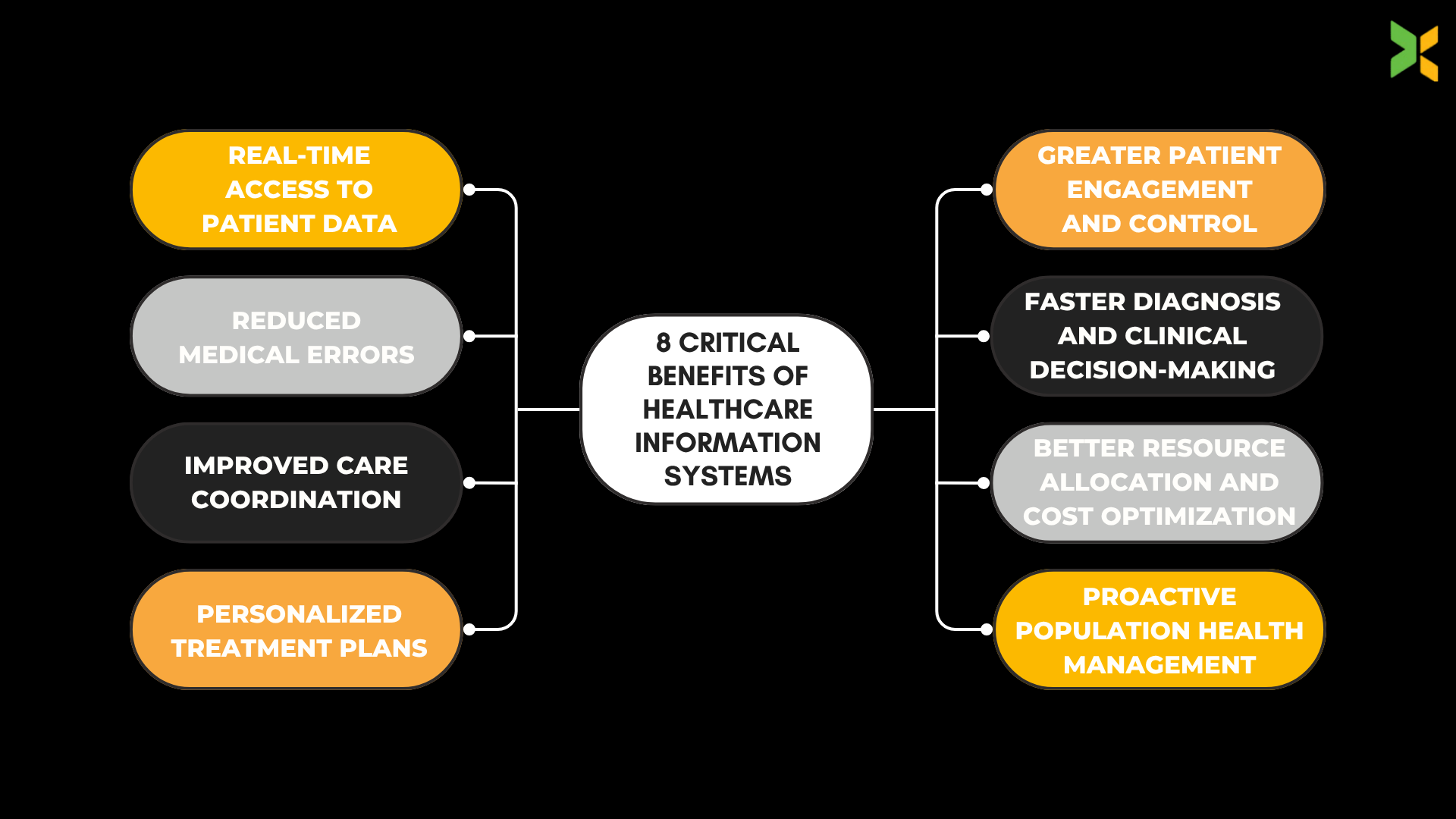
This is better than only listing the benefits because it gives Google a clear, snippet-friendly answer while also helping readers quickly understand what the section covers.
Healthcare Information Systems Comparison by Implementation Approach
Not all healthcare information systems are implemented the same way. Different approaches to healthcare information system implementation can significantly impact clinical outcomes, staff adoption, and overall efficiency. Here’s a comparison of the most common implementation approaches:
|
Implementation Factor |
Technology-First Approach |
Integrated Workflow Approach |
People-Centered Approach |
|
Primary Focus |
Latest features and capabilities |
Seamless workflow integration |
Change management and training |
|
Success Rate |
30-40% |
75-85% |
70-80% |
|
Clinical Adoption |
Low to moderate resistance |
High acceptance |
Very high engagement |
|
Time to Value |
12-18 months |
6-9 months |
3-6 months |
|
Cost Impact |
High initial, ongoing inefficiencies |
Moderate, quick ROI |
Lower total cost of ownership |
|
Patient Outcomes |
Minimal improvement |
Significant enhancement |
Dramatic improvement |
|
Staff Satisfaction |
Often decreases initially |
Steady improvement |
Marked increase |
|
Interoperability |
Limited, vendor-dependent |
Good with standards focus |
Excellent with user input |
Building the Digital Foundation for Tomorrow’s Healthcare
Creating effective healthcare information systems requires more than just installing software; it demands building a robust digital infrastructure that can adapt and grow with healthcare needs. This foundation supports not only current operations but also emerging technologies that will shape healthcare’s future.
Cloud-based architectures now enable healthcare organizations of all sizes to access enterprise-level capabilities without massive upfront investments. These systems automatically scale to handle varying patient loads and provide redundant backup systems to ensure critical health data never gets lost.
Interoperability Standards Break Down Information Silos
One of the most significant advances is the development of interoperability standards like HL7 FHIR that enable different systems to communicate seamlessly. 49% of providers cite costs as a top pain point, while 42% identify EHR integration as a close second concern. These standards mean patient data from your primary care physician can automatically flow to specialists and pharmacies without manual data entry.
Implementation failure rates drop from 60-70% to 15-25% when organizations invest equally in change management, clinical champion programs, and continuous training alongside technology deployment. This dramatic improvement shows that technical standards alone aren’t enough; successful integration requires human-centered approaches.
Artificial Intelligence Integration Enhances Clinical Decision-Making
Modern healthcare information systems increasingly incorporate AI and machine learning algorithms that analyze vast amounts of patient data to identify patterns and predict outcomes. These systems learn from millions of patient records to provide insights no individual physician could gather from limited experience.
AI can predict which patients are most likely to develop complications after surgery, enabling preventive interventions that improve outcomes and reduce costs. Fast Healthcare Interoperability Resources (FHIR) is anticipated to gain widespread adoption as a common data exchange standard, supported by major EHR vendors and healthcare organizations to enhance interoperability and allow seamless sharing of patient information among different systems.
Mobile-First Design Enables Care Anywhere, Anytime
Today’s healthcare information systems prioritize mobile accessibility, allowing healthcare providers to access patient information, review test results, and communicate with colleagues from smartphones or tablets. This mobility proves crucial for home health services, rural healthcare, and emergency response situations.
Mobile-first design also enables patients to engage with their healthcare providers through user-friendly apps that make scheduling appointments, reviewing test results, and managing medications simple and convenient.
Security and Privacy: The Non-Negotiable Foundation
Healthcare information systems employ sophisticated security measures that go far beyond basic password protection. Multi-layered approaches include biometric authentication, role-based access controls, and real-time monitoring for suspicious activity to meet stringent regulatory requirements.
Modern security architecture recognizes that protecting patient data requires constant vigilance and adaptive defenses. These systems must balance accessibility for authorized users with ironclad protection against unauthorized access or data breaches.
Zero-Trust Security Architecture
Leading healthcare information systems implement zero-trust security models that verify every access request regardless of source. This approach significantly reduces the risk of data breaches by treating every user and system as potentially compromised until proven otherwise.
Zero-trust architecture means that even users inside the healthcare network must be continuously authenticated and authorized, creating multiple layers of protection around sensitive patient information.
Blockchain Technology for Immutable Health Records
Some innovative implementations explore blockchain technology to create tamper-proof health records that patients truly own and control. This approach gives you the ability to grant specific providers access to your information while maintaining a permanent, unalterable record of your medical history.
Blockchain-based systems ensure that your health records can’t be lost, manipulated, or held hostage by any single provider or technology vendor.
The Future of Patient Care is Here
Healthcare information systems have evolved from simple digital filing cabinets into intelligent platforms that actively enhance every aspect of care delivery. They provide the foundation for safer, more efficient, and more personalized healthcare while empowering patients to take control of their health journey.
As these systems continue advancing with artificial intelligence and improved interoperability, they’ll play an even more critical role in transforming healthcare from reactive treatment to proactive, preventive care. The technology exists today to dramatically improve your healthcare experience; success depends on thoughtful implementation that puts patients first.
FAQs on Healthcare Information Systems
1. What happens to my medical records if my healthcare provider switches systems?
Modern healthcare information systems use standardized formats that ensure your records transfer between systems without information loss. Providers are legally required to maintain record access for 7-10 years, and most transitions involve temporarily running both systems to ensure seamless continuity.
2. How do these systems handle medical errors in patient records?
Healthcare information systems maintain detailed audit trails tracking every change made to patient records, including who made changes and when. If errors are discovered, providers can trace their origin and implement corrections while keeping clear documentation of what was changed and why.
3. Can healthcare systems predict my future health problems?
Advanced healthcare information systems use predictive analytics to identify risk factors for conditions like diabetes, heart disease, or certain cancers based on your medical history and population health data. While they can’t predict specific diseases with certainty, they enable earlier interventions and preventive care.