

You’re juggling EHR exports, payer audits, and “urgent” requests from clinical leaders, while your compliance team keeps reminding you that one misstep could trigger a HIPAA incident or a lawsuit.
We’ve all been there: the data exists, but it’s scattered, inconsistent, and risky to use. Research and Metrics’ latest healthcare industry analysis indicates that 73% of healthcare providers struggle with real-time compliance monitoring, leaving critical gaps in their regulatory defense.
The good news? Healthcare data management doesn’t have to be a defensive, check-the-box cost center. With the right approach, you can build a compliance-ready data foundation and turn it into a competitive advantage, better outcomes, faster decisions, and smarter growth.
The Healthcare Data Management Playbook That Turns Compliance Into Momentum
Healthcare data management sits at the intersection of patient safety, operational reality, and regulatory pressure. When it’s done poorly, you get duplicate records, delayed care, analytics nobody trusts, and constant fire drills during audits.
When it’s done well, you get clean, governed data that supports quality reporting, risk adjustment, value-based contracts, and AI initiatives, without violating privacy rules.
Most competitor content stops at generic “secure your data” advice. The real differentiator is designing a system where access is safe, data is usable, and every dataset has an owner. That’s how you move from “we hope we’re compliant” to “we can prove it, and innovate on top of it.”
Map Your Data Like a Supply Chain
Treating data flow as a clinical supply chain surfaces hidden compliance and quality failures earlier than policy reviews. You can’t fix what you can’t see, and most healthcare organizations have blind spots in their data journey from source to consumption.
Create a one-page data flow map for your top 5 workflows: EHR to billing, lab results, imaging, referrals, and patient portal access. Use tools like Lucidchart or Miro, plus your EHR interface logs and HL7 feed inventory, to trace every handoff point.
This simple exercise reveals where data gets duplicated, transformed incorrectly, or sits in limbo between systems. It’s the foundation for everything else you’ll build.
Define One Source of Truth Per Domain
“Single source of truth” fails without named domain owners who approve definitions and changes. You need someone accountable for Patient data, Provider information, Encounters, Claims, and Consent management, with clear backup assignments.
Publish definitions in a shared glossary using a data catalog like Collibra or Alation, or start simple with Notion or Confluence. The key isn’t the tool; it’s having someone who can definitively answer “which system is right?” when conflicts arise.
Without domain ownership, you’ll keep playing whack-a-mole with data inconsistencies while clinical teams lose trust in your systems.
Build Minimum Viable Governance
Governance collapses when it’s a committee; it works when it’s a small decision ladder. Establish three layers: data owners for daily decisions, weekly 15-minute triage sessions for conflicts, and monthly steering meetings for exceptions only.
Create RACI templates and use Jira or ServiceNow intake forms for data requests. This keeps governance lightweight while maintaining accountability. Most healthcare data decisions don’t need a committee; they need clear escalation paths and quick resolution.
The goal is to enable good decisions, not create bureaucracy that clinical teams will work around.
Nail HIPAA Compliance Basics
Many organizations are “configured securely” but can’t prove it during audits. AI healthcare compliance systems can reduce regulatory violations by up to 87% while cutting compliance costs by 42%. The difference lies in having audit-proof evidence trails for every access decision.
Implement quarterly access reviews for high-risk systems and maintain immutable logs of who approved what, when, and why.
This isn’t just about avoiding penalties; it’s about building a foundation that auditors trust, which reduces the time and stress of compliance reviews.
Fix Data Quality with Outcome-Tied Rules
“Completeness” and “accuracy” are meaningless unless tied to outcomes like denial rates, readmissions, or HEDIS gaps. Pick 10 rules that actually matter: missing dates of birth, inconsistent MRNs, invalid ICD-10 mapping, or missing referring provider information.
Use Great Expectations, dbt tests, or Monte Carlo for sophisticated monitoring, or start with simple SQL checks if you’re early-stage. The key is connecting data quality metrics to business outcomes that executives care about.
Quality rules without business context become compliance theater that wastes everyone’s time.
Stop Interoperability Chaos with Strategic FHIR
“Go FHIR” isn’t a strategy; targeted FHIR adoption is. Choose one or two high-impact use cases like referral workflows, patient access APIs, or care gap identification, then define your FHIR resources and mapping plan.
Use HL7 FHIR resources documentation and integration engines like Mirth Connect or Rhapsody to build focused solutions. Don’t try to FHIR everything at once; start where the business pain is highest and the technical lift is manageable.
Interoperability works when it solves real workflow problems, not when it’s implemented because it’s the “right” thing to do.
Put Consent, Retention, and Data Minimization into Your Architecture
Regulated industries such as healthcare, pharmaceuticals, energy, and the public sector are increasingly turning to hybrid cloud systems to meet stringent regulations. Consent management needs to be built into your systems, not just documented in legal policies.
Tag sensitive data categories like behavioral health, HIV status, or minor patient information, then enforce retention and access controls by tag. Use data classification frameworks and DLP policies through Microsoft Purview or Google DLP to automate enforcement.
When consent is an architectural decision rather than a policy afterthought, compliance becomes automatic instead of manual.
Make Security Measurable with Healthcare Threat Modeling
Healthcare threats are workflow-driven, phishing leads to EHR access, which leads to data exfiltration, not just perimeter security issues. Run tabletop exercises for “compromised clinician account” scenarios and verify your controls work end-to-end.
Use the MITRE ATT&CK for Healthcare framework and incident response runbooks to prepare for realistic attack patterns. Most healthcare breaches start with social engineering, so test your defenses against those specific vectors.
Security theater doesn’t protect patients; measurable, tested security controls do.
Choose the Right Architecture Based on PHI Realities
Architecture decisions should start with PHI boundaries and access patterns, not vendor marketing. Classify your datasets into PHI-heavy (restricted), de-identified/limited datasets, and operational data, then match storage and access controls accordingly.
Consider Snowflake, BigQuery, or Databricks with tokenization services, but make the decision based on your specific data governance needs. A data warehouse might be perfect for reporting, while a data lake handles unstructured clinical notes.
Don’t let technology vendors drive your architecture; let your data governance requirements and PHI realities guide the technology choices.
De-identify Data Without Creating Re-identification Risk
Many de-identification pipelines ignore linkage risk across datasets. You might safely anonymize individual tables while creating re-identification opportunities when datasets are joined together.
Define your de-identification standard upfront, Safe Harbor versus Expert Determination, and document your approach. Use specialized de-ID tools with statistical disclosure controls, and get legal and compliance review on your methodology.
De-identification isn’t just removing names and addresses; it’s preventing any combination of data points from identifying individuals.
Turn Reporting into Competitive Advantage with Metric Contracts
KPI fights happen because metric definitions aren’t versioned and agreed to. What exactly counts as a “readmission”? When does a “care gap” start and end? Create metric contracts for your 10 core KPIs with clear definitions, inclusion criteria, source tables, and refresh schedules.
Use dbt semantic layers, LookML, or metric store documentation to version and govern these definitions. When everyone agrees on what metrics mean, you can spend time acting on insights instead of arguing about data accuracy.
Competitive advantage comes from making faster decisions on trusted data, not from having more dashboards.
Operationalize Data with Real Workflows
More than 90% of healthcare workers have a clear understanding of their company’s mission and values and how their roles contribute to the organization’s success.
Competitive advantage comes from closing the loop between insight and action, not prettier dashboards.
Implement one workflow automation: missed appointment risk scoring, prior authorization status tracking, or care gap outreach triggers. Use CRM tools like Salesforce Health Cloud, workflow automation platforms, or EHR in-basket integrations to make data actionable.
When data drives real clinical and operational decisions, it becomes valuable instead of just compliant.
Build a Trust Layer for Executive Confidence
Trust is built through transparency: data lineage, freshness status, and quality indicators visible next to every metric. Add a “data status badge” to dashboards showing last refresh time, quality checks passed or failed, and data owner contact.
Use data catalog lineage features and BI annotations in Tableau or Power BI to make data provenance transparent. When executives see the data health status alongside the metrics, they stop asking “Can we trust this dashboard?”
Trust accelerates decision-making, which is where competitive advantage actually lives.
Use AI Safely with Readiness Gates
Research and Metrics’ analysis of AI implementation case studies demonstrates that predictive compliance models achieve 94% accuracy in identifying future risk areas. AI fails in healthcare when governance is retrofitted after deployment. Create an AI readiness checklist covering data quality, bias testing, PHI exposure risk, and monitoring requirements.
Require approval before any pilot touches patient data, including vendor-provided tools. Use model monitoring platforms like WhyLabs or Arize, implement bias testing protocols, and establish clear policy templates for AI governance.
AI’s potential in healthcare data analytics is enormous, but only when implemented with proper safeguards from day one.
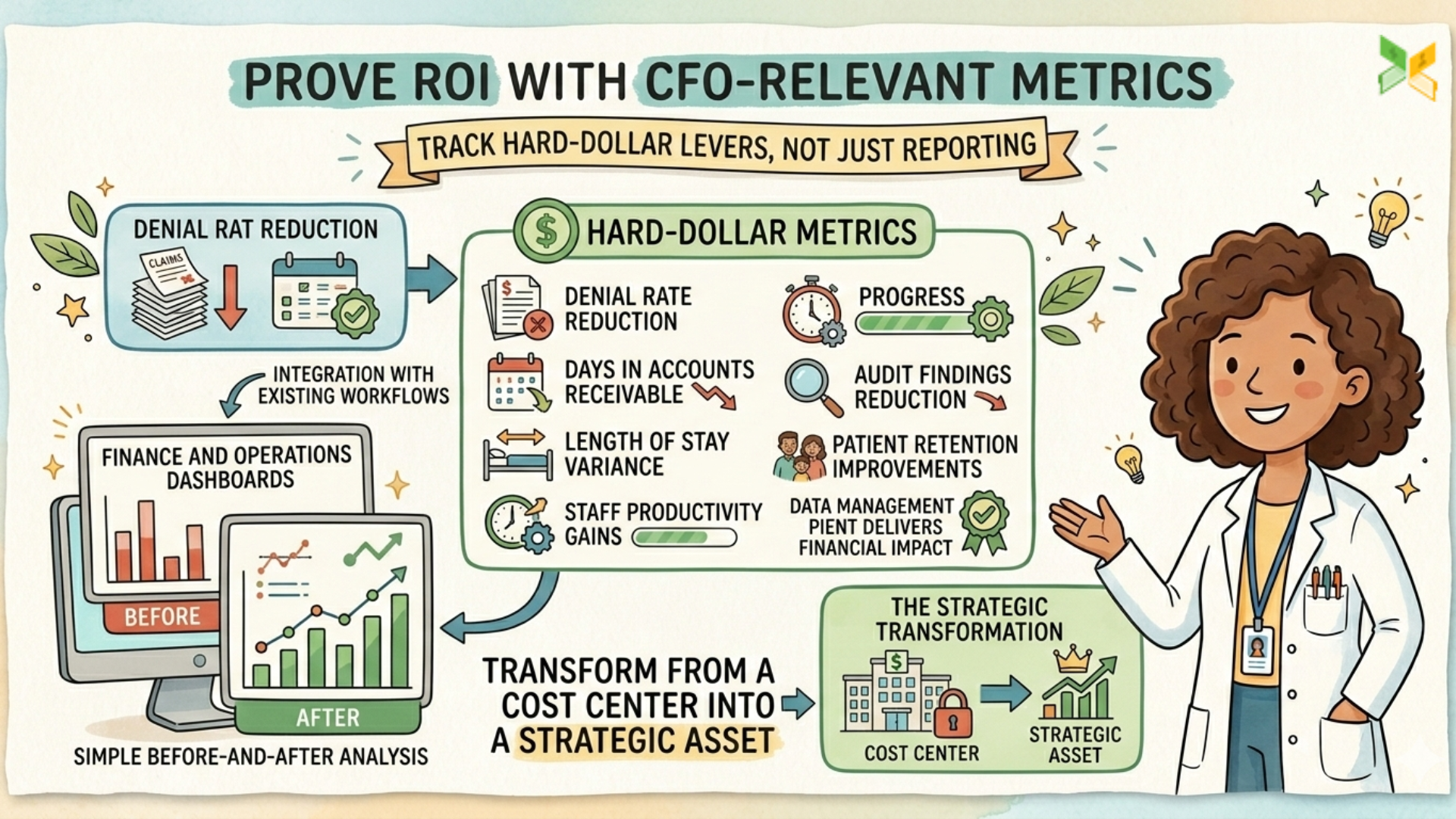
Turning Data Chaos into Strategic Advantage
The path from compliance burden to competitive asset isn’t complicated; it’s about building systematic approaches that make good data practices automatic rather than heroic. When you map workflows, assign ownership, implement lightweight governance, and connect metrics to outcomes, your data becomes a growth engine instead of a risk factor. Start with your biggest pain point, prove the approach works, then scale systematically across your organization.
Your Healthcare Data Questions Answered
1. What is healthcare data management, and why is it important for compliance and competitive advantage?
Healthcare data management is the disciplined approach to collecting, storing, governing, securing, and using health information from EHRs, claims, labs, imaging, and patient-generated sources.
2. How does healthcare data management differ from general data management?
Healthcare data has clinical consequences; bad data doesn’t just harm revenue, it can harm patients. Healthcare requires stricter privacy controls, complex medical coding systems, and heavy interoperability needs through HL7/FHIR standards. Unlike general business data, healthcare information involves patient consent, clinical provenance tracking, and life-or-death decision support that demands higher accuracy and security standards.
3. What are the biggest compliance challenges in healthcare data management?
Common challenges in healthcare data management include access sprawl across clinical systems, inconsistent audit logging, third-party vendor risk, and shadow IT through spreadsheets and screenshots.