
Picture this: you’re managing a chronic condition, and your doctor asks, “How have you been feeling since your last visit?”
You struggle to remember specific symptoms from three weeks ago, giving vague responses that don’t truly capture your health journey.
Mobile apps are revolutionizing patient reported outcomes by capturing real-time data, transforming healthcare communication, and empowering you to take control of your health story. Many platforms now incorporate patient reported outcome measures, helping translate your daily experiences into structured clinical insights.
Why Traditional Patient Reporting Methods Are Failing Modern Healthcare
Healthcare has relied on outdated methods for collecting patient feedback for decades.
- Paper questionnaires
- Rushed office visits
- Memory-based reporting
These create significant gaps in understanding patient experiences. These traditional approaches often miss crucial health patterns, leading to delayed interventions and suboptimal care decisions.
Where the Communication Breaks Down
The disconnect between what patients experience and what doctors document represents one of healthcare’s biggest communication breakdowns.
- Patients often can’t remember exactly when symptoms started
- Details like severity on a specific day get forgotten
- Providers end up making treatment decisions with incomplete information
This guesswork approach doesn’t serve anyone well.
How Mobile Apps Solve the Issue
Mobile apps address these fundamental flaws by providing:
- Continuous reporting
- Accurate data
- Comprehensive patient-reported outcome measures
Unlike sporadic clinic visits, apps capture health information in real-time, creating a complete picture of patient wellbeing without relying on faulty memory.
For example, a review found that of mobile apps aimed at patient-reported outcomes, 73.1% of the studies reviewed reported a significant improvement in outcomes.
Real-Time Data Collection Eliminates Memory Bias
Memory bias affects nearly every patient interaction with healthcare providers. You might remember the worst day of the past month while forgetting the gradual improvement that occurred. Real-time data collection is possible with apps. It captures symptoms as they happen, providing accurate health measurements that reflect true patterns rather than selective recall.
How Real-Time Tracking Helps
- Daily symptom tracking builds chronological health records
- Logging pain levels at specific times (e.g., 3 PM on a Tuesday) provides objective detail
- Immediate recording of medication side effects gives clinicians precise, actionable data
Standardized Metrics Create Consistent Communication
Apps using validated assessment tools provide clinically meaningful data that traditional methods often lack.
Why Standardized Metrics Matter
- Instead of vague descriptions like “pretty bad” pain or “not great” energy
- Standardized scales create consistent language between patients and providers
- Feedback becomes easier to compare over time, leading to better clinical decisions
These metrics transform subjective experiences into objective data points that providers can track over time. When apps use established questionnaires rather than generic rating systems, your feedback translates into actionable medical insights that directly inform treatment decisions.
By converting everyday symptom reports into structured health measurements, apps give clinicians a clearer foundation for making timely and personalized care adjustments.
In one proof-of-concept study involving rheumatoid arthritis patients, app use showed an app retention rate of 71.7% over three months, with 87% of patients stating it was easier to document disease course via the app than through clinic visits alone.
The shift from narrative descriptions to quantifiable data represents a fundamental change in how healthcare teams understand patient experiences. This transition creates the foundation for everything that follows in modern digital health.
How Mobile Apps Transform Patient Engagement and Ownership
Patient engagement has traditionally been passive, with individuals receiving care rather than actively participating in health management.
Mobile apps fundamentally shift this dynamic by putting powerful health monitoring tools directly in your hands, creating unprecedented levels of personal health awareness and control.
This transformation goes beyond simple data collection. Apps create partnerships between patients and providers, where daily health information becomes the foundation for collaborative treatment decisions.
You’re no longer just a recipient of care but an active participant in managing your health outcomes.
Personalized Health Dashboards Make Complex Data Accessible
Visual representations of health trends help you understand your condition better than raw clinical data ever could. When you see your pain levels decrease over six weeks or notice energy improvements after medication adjustments, these patterns become clear motivators for continued treatment adherence.
Customizable dashboards let you track metrics most relevant to your specific condition, creating your personal health narrative over time.
These visual stories reveal connections between lifestyle factors, treatments, and symptoms that might otherwise remain hidden in traditional healthcare encounters.
Automated Reminders and Notifications Improve Treatment Adherence
Smart notification systems that adapt to your behavior patterns show significantly better results than generic reminder schedules. Apps learn when you’re most likely to take medications or complete symptom assessments, optimizing reminder timing for your daily routines.
Setting up medication and symptom tracking reminders during consistent daily activities builds sustainable health monitoring habits. When reminders integrate naturally into your existing schedule, tracking becomes second nature rather than another burden to manage.
These engagement tools create the infrastructure for sustained health improvement, setting the stage for more advanced clinical applications that can truly improve patient outcomes.
Revolutionary Clinical Applications Reshaping Treatment Decisions
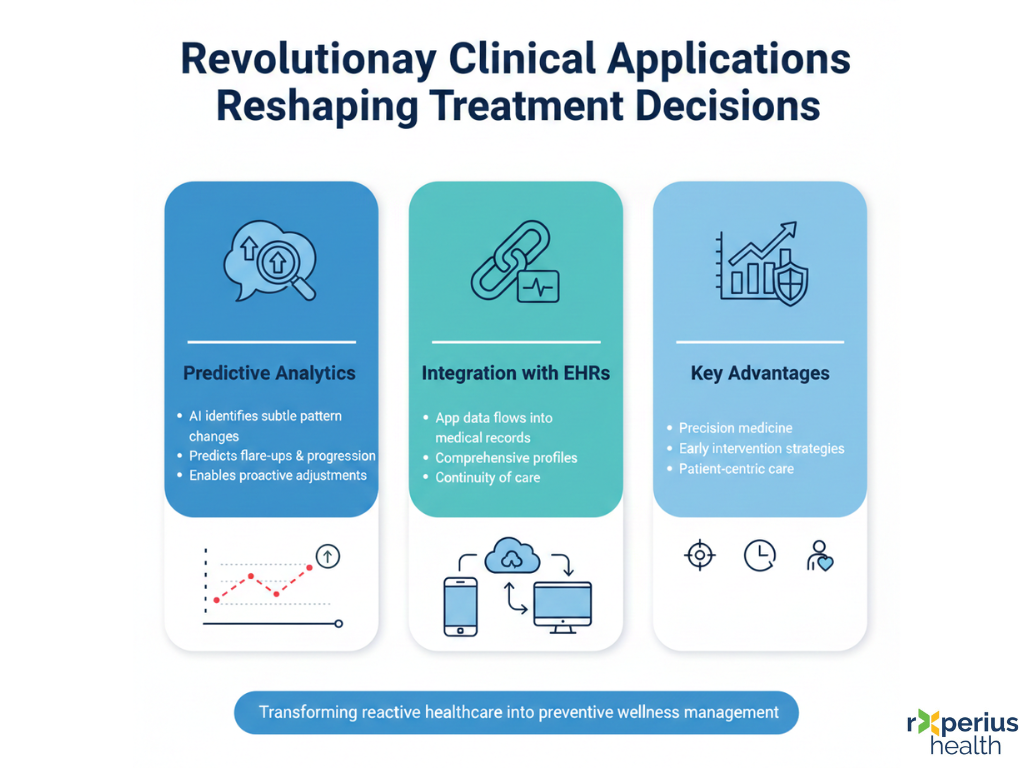
Healthcare providers are discovering that mobile app data provides insights impossible to obtain through traditional clinical encounters. This continuous stream of patient-reported information enables precision medicine approaches and early intervention strategies that were previously unattainable in standard practice settings.
The clinical revolution isn’t just about having more data. It’s about having the right data at the right time to make treatment decisions that actually reflect patient experiences. When providers can see daily symptom patterns instead of monthly snapshots, treatment becomes proactive rather than reactive.
For instance, rXperius’s research and resource library outlines how real-time patient-driven data (including social determinants of health) empowers predictive modelling and early intervention.
Predictive Analytics Identify Health Deterioration Before Symptoms Worsen
Machine learning algorithms can detect subtle pattern changes in your data weeks before traditional clinical assessments would identify problems. These systems analyze thousands of data points to predict flare-ups, medication failures, or disease progression before you even notice symptoms changing.
Apps that offer trend analysis and share predictive data with healthcare teams enable proactive treatment adjustments. Instead of waiting for your next appointment to discuss worsening symptoms, providers can intervene early when treatments are most effective.
Integration with Electronic Health Records Creates Comprehensive Patient Profiles
The seamless flow of app data into clinical systems eliminates the traditional disconnect between patient experiences and medical records. When your daily symptom logs automatically populate your medical chart, providers have complete information for every appointment and treatment decision.
Choosing apps that integrate with your healthcare provider’s system ensures your daily health data directly informs your treatment plan.
This integration creates continuity between self-monitoring and professional care that was impossible with traditional reporting methods.
|
Feature |
Traditional Methods |
Mobile App Integration |
|
Data Frequency |
Monthly visits |
Daily tracking |
|
Memory Accuracy |
Subject to recall bias |
Real-time capture |
|
Provider Access |
Limited to appointments |
Continuous availability |
|
Pattern Recognition |
Difficult to identify |
Automated analysis |
|
Treatment Timing |
Reactive adjustments |
Proactive interventions |
This data integration represents the technical foundation that makes advanced healthcare delivery possible, though it also raises important questions about privacy and data security.
Addressing Privacy Concerns and Building Patient Trust
Data security represents the biggest barrier to widespread adoption of health apps, yet most discussions oversimplify the complex privacy considerations involved. Understanding how to evaluate and use these tools safely empowers you to benefit from mobile health technology while protecting personal information.
The privacy conversation isn’t just about whether your data is safe. It’s about understanding who controls your health information, how it’s used, and what happens when you want to share or restrict access to specific details.
HIPAA Compliance and Encryption Standards Vary Dramatically Across Apps
Many popular health apps don’t meet the same security standards as hospital systems, creating vulnerability gaps most users don’t recognize.
Are patient reported outcomes worth it if the data isn’t properly protected? The answer depends entirely on choosing platforms that prioritize security. Most of the advanced platforms also align their tools with patient-reported outcome measures to ensure that securely collected data remains clinically useful.
Only use apps that explicitly state HIPAA compliance and offer end-to-end encryption. Ask your healthcare provider for recommended platforms that meet clinical security standards rather than relying on consumer app store ratings alone.
Data Ownership and Control Features Put Patients in Charge
The ability to control who accesses your health data and how it’s used represents a fundamental shift toward patient-centered healthcare. Modern apps should let you grant and revoke data access to specific healthcare providers or researchers as your needs change.
Review app permissions carefully and choose platforms that put you in control of your information. Data ownership features ensure that your health information remains yours, even as you share it strategically to improve care quality.
These privacy protections create the trust necessary for patients to embrace emerging technologies that promise even greater health benefits.
Emerging Technologies and Future Healthcare Integration
The next generation of patient-reported outcome apps will incorporate artificial intelligence, wearable device integration, and predictive modeling capabilities that transform reactive healthcare into preventive wellness management. These advances promise to make current apps seem primitive by comparison.
Future integration won’t just improve existing features. It will create entirely new ways of understanding health that blur the lines between patient self-monitoring and clinical assessment, making healthcare more personalized and predictive than ever before.
AI-Powered Symptom Analysis Provides Instant Health Insights
Advanced algorithms can now interpret patient-reported symptoms in real-time, offering instant health insights and recommendations between medical appointments. These systems learn from millions of patient interactions to provide personalized insights that traditional healthcare delivery simply cannot match.
Explore apps with AI symptom checkers as supplementary tools, but always confirm significant health concerns with your healthcare provider for an accurate diagnosis. The technology supports but doesn’t replace professional medical judgment.
Wearable Device Integration Creates Comprehensive Health Pictures
Combining subjective patient reports with objective biometric data from wearables provides unprecedented insight into health patterns and triggers. This multi-dimensional approach reveals connections between activity, sleep, and symptom patterns that were previously invisible.
Pair your symptom tracking app with compatible fitness trackers or smartwatches to create complete health profiles. These integrated systems can identify correlations between physical activity and symptom severity that help optimize both treatment and lifestyle choices.
Taking Control of Your Health Future
Mobile apps are fundamentally transforming patient reported outcomes from sporadic, memory-based guesswork into continuous, data-driven health insights.
These tools empower you to become an active participant in your healthcare journey while providing medical teams with the detailed information needed for personalized treatment decisions. Ultimately, this shared data ecosystem helps improve patient outcomes across conditions and care settings.
Ready to take control of your health story? Start by discussing mobile apps with your healthcare provider and exploring platforms that integrate with your current medical system.
FAQs on Mobile Apps for Patient Outcomes
1. Can mobile health data be used in clinical research and drug development?
Yes, anonymized patient-reported outcome data from mobile apps is increasingly valuable for pharmaceutical research, clinical trials, and population health studies through opt-in participation.
2. How accurate are mobile apps compared to traditional clinical assessments?
Studies show mobile apps often provide more accurate data than traditional methods because they eliminate recall bias and capture symptoms in real-time.
3. Do healthcare providers actually review the data from mobile apps?
Yes. When integrated with clinical systems, providers can access and use the data during visits and for ongoing care decisions.