

Picture this: You’ve just launched a diabetes management program backed by traditional survey data showing patients want “better support.” Six months later, adoption rates are terrible, and you’re scrambling to understand what went wrong. The problem? Your research captured what patients said they wanted, but completely missed the emotional rollercoaster they actually experience, from morning glucose panic to dietary guilt to insurance frustration.
Between 2019 and 2023, point-of-care spending among healthcare organizations grew by 171%, reaching approximately $803 million with a compound annual growth rate of around 22% per year, signaling a massive shift toward understanding real patient moments rather than isolated opinions. This disconnect between stated preferences and lived reality is exactly why patient journey market research is revolutionizing healthcare insights.
What Makes Patient Journey Market Research Different?
Patient journey market research isn’t just traditional research with a healthcare twist; it’s a fundamentally different way of understanding how people experience health challenges. While traditional market research asks patients what they think about your product at a single moment, patient journey research follows them through the entire experience, from first symptoms to long-term management. This approach captures the messy, non-linear reality of healthcare decisions that surveys simply can’t touch.
The distinction matters more than ever in today’s patient-centric landscape. Traditional methods might tell you that 65% of patients are “satisfied” with their care, but patient journey analysis reveals the three critical moments where they almost gave up entirely, insights that directly inform where to intervene. It maps emotions, behaviors, and touchpoints across time, creating a narrative that explains not just what’s happening, but why it’s happening and what it means for your strategy. Think of traditional research as a photograph and patient journey research as a documentary film. Both have value, but only one captures movement, change, and the story that connects individual moments into meaningful patterns.
Understanding this difference helps you choose the right tool for your specific challenge, whether you’re launching a new treatment or trying to fix retention problems.
Core Methodology Differences: How Each Approach Actually Works
Let’s break down what each method actually looks like in practice, because the differences go way beyond just timelines and budgets.
Traditional Market Research, The Snapshot Method
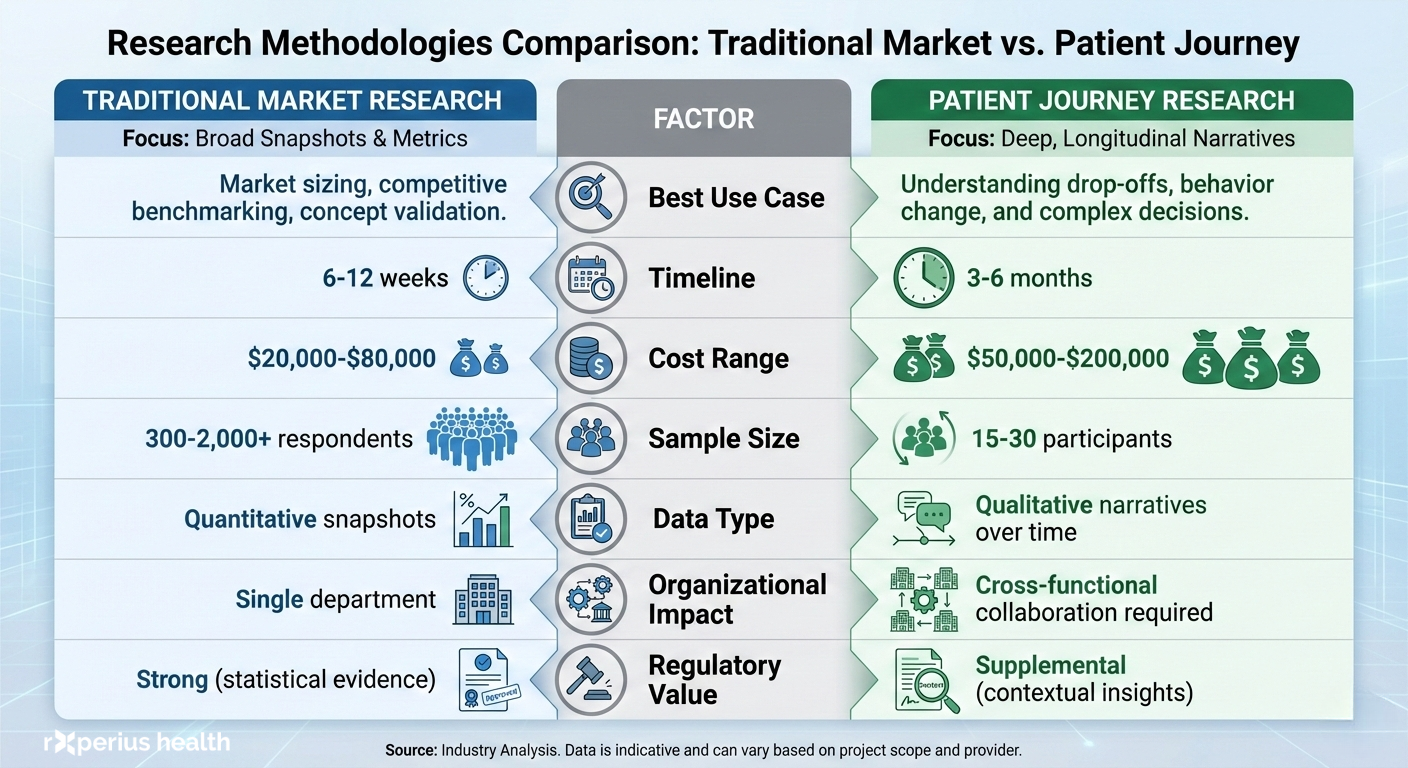
Traditional market research relies on established tools like surveys, focus groups, and quantitative polling to gather broad data at specific moments. You’re asking 500 diabetes patients to rate their satisfaction with your CGM device on a scale of 1-10, or running a focus group to discuss brand perceptions.
The strength lies in statistical validity and scalability; you can quickly benchmark against competitors and identify general trends. Research shows that 82% of patients value health information at their doctor’s office or hospital, yet traditional methods often miss why this context matters so much. Most projects cost $20,000 to $80,000 and deliver results within 6 to 12 weeks, making them efficient for validation and market sizing.
Patient Journey Research, The Narrative Method
Patient journey research employs longitudinal tracking, in-depth interviews, ethnographic observation, and journey mapping workshops to understand experiences over time. Instead of asking about your CGM in isolation, you’re shadowing patients through their entire diabetes management routine, from 3 AM alarm anxiety to pharmacy insurance battles to the relief of stable readings.
This often involves diary studies, video ethnography, and multi-stakeholder interviews with patients, caregivers, and providers. Projects typically range from $50,000 to $200,000 and span 3 to 6 months, but uncover emotional triggers and behavioral patterns that surveys miss entirely. One study found that patient journey mapping may contribute as a review and audit tool, or a mechanism for providing proactive patient-centered care, revealing needs that traditional methods overlook.
Here’s what most teams don’t realize: the most effective research strategies blend both approaches. Use traditional methods to quantify the “what” and “who,” then deploy journey research to understand the “why” and “how.” For example, start with a quantitative survey to identify that 40% of patients abandon treatment in month three, then use journey interviews to discover it’s because insurance reauthorization coincides with holiday stress, a specific, actionable insight you can actually fix.
With these methodological foundations clear, it’s worth examining when each approach truly shines in real-world applications.
When Patient Journey Research Outperforms Traditional Methods
So, when does the additional investment in journey research actually pay off? Here are three scenarios where it consistently outperforms traditional approaches.
High Patient Drop-Off Without Clear Cause
Traditional exit surveys tell you patients left, journey research reveals the specific moment everything fell apart. In a 2024 chronic pain study, surveys showed “cost concerns” as the top reason for discontinuation, but journey mapping exposed that patients actually struggled with the 47-minute phone authentication process required for each refill, a fixable friction point hidden beneath generic feedback.
Point-of-care marketing revenue surpassed $1 billion in 2024, a robust 16% increase over 2023’s revenue of $870 million, largely because companies mapped actual patient moments rather than relying on satisfaction scores. If your retention metrics remain flat despite addressing stated concerns from traditional research, it’s time to map the actual patient experience journey to uncover operational barriers surveys miss entirely.
Digital Health Tools Requiring Behavior Change
Apps and devices fail 60% of the time due to poor adoption, not poor technology. Traditional usability testing measures task completion, but journey research reveals why that meditation app gets deleted after three uses, because patients feel guilty seeing the “7-day streak broken” notification while managing a lupus flare.
Research indicates that 58% of patients and caregivers who encountered a pharmaceutical ad in the office reported that it made them more knowledgeable about their medications, a 12% increase from previous years. This context shapes entirely different design decisions, from notification timing to motivational messaging frameworks that account for chronic illness realities. When you’re launching digital health solutions that require sustained engagement, journey research uncovers the emotional landmines traditional testing completely misses.
Multiple Stakeholder Decision Processes
Rare disease treatments often involve patients, caregivers, specialists, insurers, and care coordinators, each with different priorities and pain points. Traditional research tends to silo these perspectives, interviewing each group separately about their satisfaction. Journey research maps how these stakeholders interact across the care continuum, revealing that the real bottleneck isn’t patient hesitation, as surveys suggested, but the two-week gap between genetic counselor recommendations and insurance pre-authorization, during which 35% of families lose momentum.
For truly novel solutions, think continuous glucose monitors before they became mainstream or digital therapeutics for insomnia; traditional research often yields confusing data because patients lack reference points. Journey research contextualizes the problem space first, revealing the workaround behaviors and unmet needs your innovation could address.
Before you conclude that patient journey research is always superior, let’s examine where traditional methods not only compete but actually outperform.
When Traditional Market Research Remains Superior
Traditional research still wins in several critical situations, and knowing when to use it saves both time and money. If you’re testing four ad concepts for a well-established cholesterol medication or comparing pricing tiers for a pharmacy benefit, traditional A/B testing and quantitative surveys deliver faster, more cost-effective answers. Patient journey research provides depth, but when you need to validate assumptions across 2,000 respondents in three weeks, traditional methods are built for this efficiency.
Need to know your brand awareness versus competitors, or size the addressable market for a new oncology indication? Traditional market research excels at these foundational questions. Journey research might reveal that pancreatic cancer patients feel “invisible” in the healthcare system, but it won’t tell you that there are 64,000 new diagnoses annually with a $4.2 billion treatment market, data you need for business cases.
FDA submissions, health technology assessments, and payer negotiations often require specific quantitative endpoints and statistical rigor that traditional randomized controlled surveys provide.
While journey insights can enhance market access strategies, they typically supplement rather than replace the statistical evidence regulators demand. Early-stage startups or fast-moving generics don’t always have $150,000 and four months for comprehensive journey mapping. Starting with a $15,000 traditional survey to identify promising opportunity areas makes practical sense.
With the strengths and limitations of both approaches clear, here’s how to make the call for your specific situation.
How to Make the Right Choice for Your Project
Choosing between these approaches doesn’t have to feel overwhelming if you follow a systematic decision process that matches method to need.
The Three-Question Decision Framework
Start with these three critical questions: Do I need to understand experiences across multiple touchpoints over time, or validate a specific claim right now? Will insights require action from multiple departments, or can one team act on findings independently? Is the behavior I’m studying well-understood and rational, or emotionally complex and poorly articulated by patients? If you answered “across time,” “multiple departments,” and “emotionally complex,” lean toward patient journey research.
Two or more “validate, independent, rational” answers suggest traditional methods will serve you better. Can’t decide or don’t have buy-in for a full journey study? Run a 4 to 6 week “journey sprint” that combines both methods: deploy a traditional quant survey to 300 to 500 patients, identifying key pain points and segmentation, then conduct 15 to 20 in-depth journey interviews with representative patients from high-value segments to add narrative depth. This $25,000 to $40,000 hybrid delivers enough statistical validity to satisfy skeptics while providing the “aha moments” that only stories provide.
Red Flags You’ve Chosen Wrong
You’ve chosen wrong if your patient journey research outputs look like a linear funnel chart; real journeys are messy and non-linear. If your traditional survey results keep saying “patients want better communication,” but no one knows what that means, you need qualitative depth. When journey research drags past six months with no actionable insights, you’re probably over-complicating and should simplify or pivot. If traditional research contradicts observable behavior, like high satisfaction scores despite terrible retention, trust behavior, and investigation with journey methods to uncover what’s really happening beneath surface-level responses.
Here’s a comparison to help you decide which approach fits your needs:
Making Smarter Research Decisions in Healthcare
The choice between patient journey market research and traditional market research isn’t about which is “better,” it’s about matching method to the question you’re trying to answer.
Traditional research delivers the scalable validation and competitive benchmarking that build business cases and measure campaign effectiveness, while journey research uncovers the emotional undercurrents, behavioral patterns, and systemic friction points that surveys miss but that ultimately determine whether patients stay engaged with your treatment, app, or service.
The healthcare organizations winning right now aren’t choosing one or the other; they’re building research capabilities that deploy both strategically, using traditional methods to map the landscape and identify opportunity areas, then journey research to go deep on the moments that matter most.
Ready to understand not just what patients think, but what they actually experience? Start by auditing your current research portfolio and asking whether everything you know comes from surveys asking patients to evaluate your products, because if it does, you’re missing half the story.
Common Questions About Choosing Research Methods
1. When should I absolutely use patient journey research instead of traditional surveys?
When patient drop-off rates are high without clear reasons, when launching digital tools requiring sustained behavior change, or when multiple stakeholders influence treatment decisions, journey research consistently uncovers actionable insights traditional methods miss.
2. How do I justify the higher cost of journey research to leadership?
Point to specific ROI examples: one brand using point-of-care journey insights saw double-digit growth and 56% cost reduction per new patient start, while traditional satisfaction scores showed no predictive value for retention or adherence improvements.
3. Can I combine both approaches in one project?
Absolutely, and you probably should. Use traditional quant research to identify what’s happening and journey research to understand why. This hybrid approach delivers statistical validity plus narrative depth that drives cross-functional action and implementation success.