

Picture a patient leaving your hospital frustrated about long wait times and unclear discharge instructions, but you don’t find out until they post a negative review weeks later. One of the most significant drawbacks of traditional patient satisfaction surveys, such as HCAHPS, is the delay in feedback.
Surveys are typically administered days or even weeks after a patient’s visit, making it difficult to identify and address issues in real-time. Real-time surveys change this completely by transforming static patient journey mapping into dynamic tools for improving care.
Real-Time Feedback Creates Living, Breathing Patient Journey Maps
Traditional patient journey analysis has been a static exercise where teams create diagrams based on assumptions and outdated data, then file them away until the next quarterly review. Real-time surveys transform this approach by turning journey maps into living documents that change with every patient interaction.
Unlike delayed post-visit surveys that arrive when memories have faded, real-time feedback captures emotions and experiences at their peak intensity. When a patient rates their waiting room experience immediately after check-in or provides feedback about discharge instructions while still in their hospital bed, the data is fresh, accurate, and actionable. This continuous flow of feedback allows healthcare teams to spot patterns and problems as they emerge rather than discovering issues months later.
In fact, in 2023, ambulatory surgery (85.3 out of 100 top-box ‘Likelihood to Recommend’ rating) and medical practices (84.1) reached a five-year high. This improvement demonstrates how real-time feedback systems help organizations achieve measurable gains in patient satisfaction. Your patient journey maps become real-time dashboards that reflect current patient sentiment across every touchpoint.
This transformation enables healthcare teams to move from reactive problem-solving to proactive care improvement, creating a foundation for the ten key ways real-time surveys reshape patient experiences.
10 Ways Real-Time Surveys Transform Patient Journey Mapping
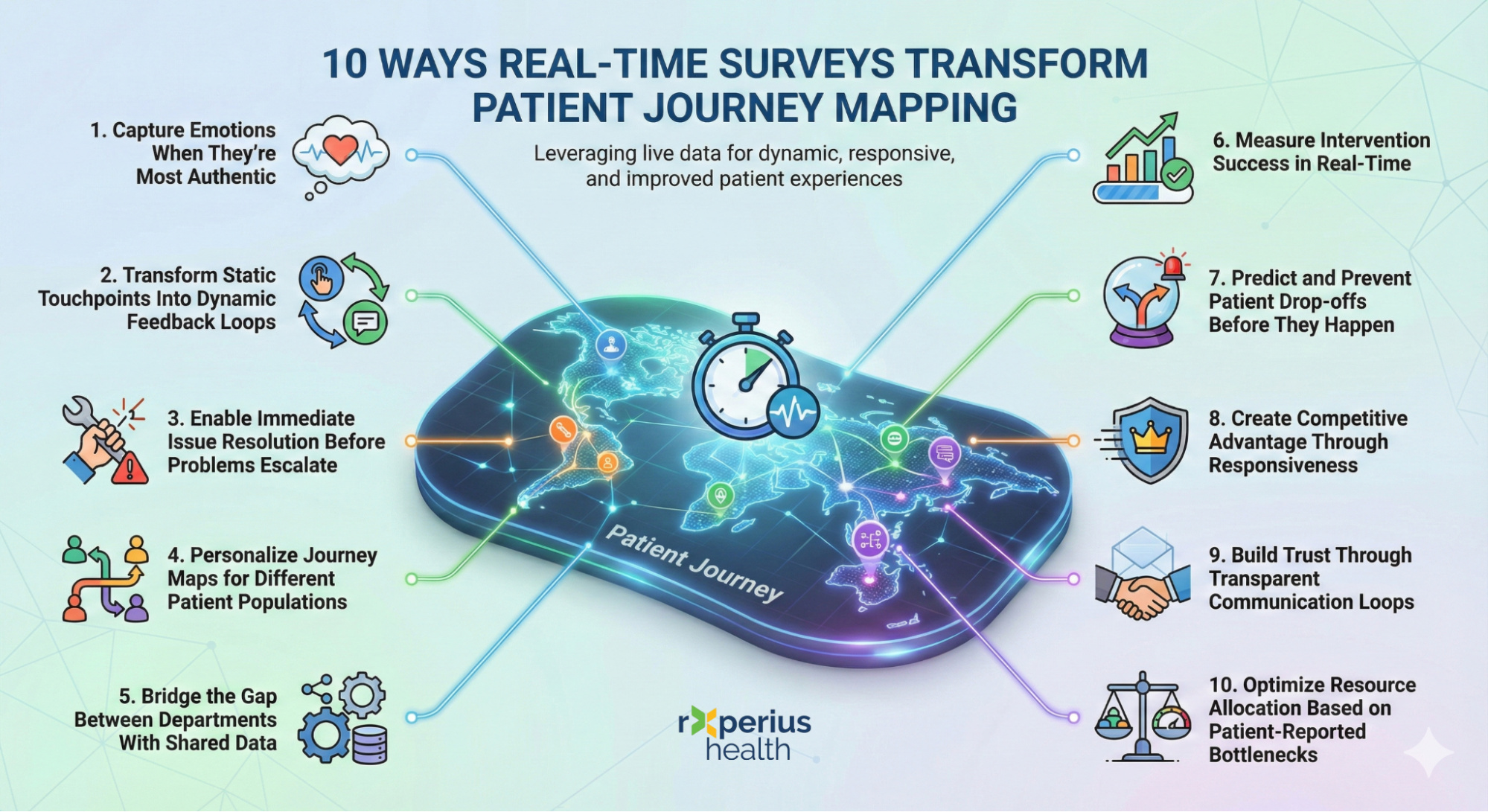
1. Capture Emotions When They’re Most Authentic
Real-time surveys catch patients when their feelings are most genuine and detailed. A patient who just experienced excellent bedside manner from a nurse will provide more specific, enthusiastic feedback than someone trying to recall the interaction weeks later. Similarly, frustrations about confusing signage or uncomfortable waiting areas are captured with vivid clarity when experienced immediately.
This emotional authenticity gives you precise details about what needs fixing rather than vague recollections that lose their power over time. Fresh feedback reveals not just what happened, but how it felt, providing the emotional context that drives meaningful improvements in patient journey mapping.
2. Transform Static Touchpoints Into Dynamic Feedback Loops
Traditional journey maps identify touchpoints but can’t tell you how they’re actually performing. Real-time surveys convert each touchpoint into a data collection opportunity that continuously informs your understanding of the patient experience.
Your appointment scheduling system becomes a feedback source about booking ease. Your discharge process generates immediate insights about instruction clarity. Every patient interaction becomes a chance to validate or challenge your assumptions about the patient journey. This dynamic approach ensures your maps reflect reality rather than hopeful projections.
3. Enable Immediate Issue Resolution Before Problems Escalate
When a patient reports confusion about medication instructions through a real-time survey, staff can address it within hours rather than discovering the issue through readmission data months later. This proactive approach prevents small problems from becoming major complaints, reduces negative online reviews, and demonstrates to patients that their feedback matters.
Immediate issue resolution transforms patient perception from “they don’t listen” to “they really care about my experience.” This rapid response capability changes the entire dynamic of patient relationships and builds trust that extends well beyond a single visit.
4. Personalize Journey Maps for Different Patient Populations
Real-time data reveals how different patient groups experience your services differently. Elderly patients might struggle with digital check-in kiosks while younger patients find them convenient. Parents with children have different waiting room needs than solo patients visiting for routine procedures.
Patient journey market research through real-time feedback helps you create multiple journey map variations that reflect these diverse experiences, rather than assuming one size fits all. This personalization allows you to address specific needs and improve satisfaction across all patient populations.
5. Bridge the Gap Between Departments With Shared Data
Real-time surveys provide a common language for different departments to understand their impact on the overall patient experience. When the lab department sees that delayed test results are causing anxiety spikes in patient feedback, they understand their role in the journey beyond just processing samples.
Facilities that score at the top for employee engagement are 3x more likely to perform at the top in patient experience, too. This shared visibility breaks down silos and encourages collaborative improvement efforts across departments, creating alignment that benefits both staff and patients.
6. Measure Intervention Success in Real-Time
When you implement changes based on patient feedback, real-time surveys let you measure their impact immediately rather than waiting for quarterly satisfaction scores. If you redesign your discharge process, you’ll see feedback scores improve or decline within days, allowing for quick adjustments.
Nationally, things are looking up. Across all settings, we’re seeing patient experience scores rise. This rapid iteration cycle speeds up improvement and prevents you from pursuing ineffective solutions for months. Real-time measurement transforms improvement from a lengthy process into an agile practice.
7. Predict and Prevent Patient Drop-offs Before They Happen
Patterns in real-time feedback can signal when patients are becoming disengaged or frustrated before they abandon care entirely. A series of declining satisfaction scores from a chronic care patient might indicate they’re struggling with treatment adherence before it shows up in clinical metrics.
Early intervention based on these signals can prevent costly readmissions and improve health outcomes. Patient journey examples from real-time data help you identify warning signs and create preventive strategies that keep patients engaged throughout their care journey.
8. Create Competitive Advantage Through Responsiveness
Most healthcare organizations still rely on quarterly patient satisfaction surveys that provide historical data with little actionable value. By implementing real-time feedback systems, you differentiate yourself as an organization that truly listens and responds quickly to patient needs.
This responsiveness becomes a powerful marketing tool and referral driver. Patients notice when their concerns are addressed quickly, and they share these positive experiences with others. Your ability to act on feedback immediately sets you apart from competitors still operating on delayed feedback cycles.
9. Build Trust Through Transparent Communication Loops
When patients see that their feedback leads to immediate improvements, trust deepens significantly. A patient who reports difficulty finding parking and then sees new directional signs installed the following week becomes an advocate for your organization.
Real-time surveys close the communication loop between feedback and action, demonstrating genuine commitment to patient experience. This transparency builds loyalty that extends far beyond individual visits and creates patients who actively recommend your services to others.
10. Optimize Resource Allocation Based on Patient-Reported Bottlenecks
Real-time feedback reveals resource allocation problems that operational data might miss. If patients consistently report feeling rushed during appointments, you might need to extend appointment slots rather than seeing more patients per hour. If wayfinding is a recurring complaint, investing in better signage might have more impact than hiring additional staff.
Patient-reported bottlenecks guide strategic resource decisions with precision that internal metrics can’t match. This patient-centered approach to resource allocation ensures investments address real problems rather than perceived ones.
These transformative capabilities demonstrate why real-time surveys are becoming essential tools for modern healthcare organizations seeking to improve patient experiences systematically.
|
Traditional Journey Mapping |
Real-Time Survey Integration |
|
Static quarterly updates |
Living, dynamic feedback loops |
|
Historical data analysis |
Immediate issue identification |
|
Assumption-based improvements |
Patient-validated changes |
|
Department-specific views |
Cross-functional shared insights |
|
Generic patient experience |
Personalized journey variations |
FAQs on Real-Time Survey Implementation
- How quickly should surveys be sent after patient interactions?
The optimal window is within 30 minutes to 2 hours after the interaction, depending on the touchpoint, to capture feedback while experiences remain fresh.
- What’s the ideal length for real-time patient surveys?
Keep surveys to 2-3 questions maximum for real-time feedback to maintain high completion rates and capture immediate reactions effectively.
- How do you handle survey fatigue in patients with multiple touchpoints?
Implement smart triggering that surveys only critical touchpoints and space surveys 48-72 hours apart for frequent visitors.
- Can real-time surveys violate HIPAA regulations?
Real-time surveys are HIPAA-compliant when properly implemented using secure, encrypted platforms and focusing on experience rather than clinical details.
- What delivery methods work best for different patient demographics?
Younger patients prefer SMS and app-based surveys, middle-aged patients respond well to email, while older patients often prefer phone or paper options.
The Future of Patient Feedback Systems
Real-time surveys transform patient journey mapping from a static planning exercise into a dynamic improvement system that changes with every patient interaction. By capturing feedback when emotions and memories are most accurate, you gain unprecedented insight into the actual patient experience rather than assumptions about it.
The use of digital platforms for patient surveys is increasing. These platforms offer convenience, real-time data collection, and advanced analytics capabilities. Healthcare organizations thriving in today’s patient-centered environment are those that listen, learn, and adapt quickly through immediate feedback systems that turn patient voices into competitive advantages.