

Picture this: You’re a healthcare provider watching patients repeatedly miss appointments, struggle with medication compliance, or arrive at your clinic with advanced conditions that could have been prevented. Sound familiar?
These scenarios aren’t just about individual choices—they’re symptoms of deeper community health barriers and broader barriers to health that affect millions of Americans daily. Patients facing housing instability remain hospitalized longer than those with stable housing (6.7 vs. 4.8 days).
Understanding these barriers transforms not just individual patient outcomes, but entire healthcare systems.
The Hidden Crisis: Why Community Health Barriers Shape Everything We Do in Healthcare
Community health barriers represent one of the most underestimated forces in healthcare today. While medical professionals focus intensively on clinical protocols and treatment innovations, the invisible walls preventing patients from accessing and benefiting from care often determine outcomes more than any medication or procedure ever could.
These barriers to good health operate like a complex web, interconnecting social, economic, cultural, and systemic factors that either help or block a person’s journey to wellness. When a diabetic patient can’t afford their insulin, when a pregnant mother has no transportation to prenatal appointments, or when a family avoids seeking mental health services due to cultural stigma, we’re witnessing barriers to health in action.
What makes understanding these barriers so critical is that they’re often invisible to healthcare providers who work within clinical settings. A patient who seems “non-compliant” may actually be navigating multiple systemic obstacles that make following medical advice nearly impossible.
Socioeconomic Barriers Create the Foundation of Health Inequity
Economic hardship creates the foundation for community barriers and most other barriers to good health. When families must choose between rent and prescription medications, or when parents skip their own medical appointments to pay for their children’s school supplies, we see how financial stress directly impacts health outcomes.
The financial burden from repeated re-observation stays is significant, with average costs reaching $528 per stay without a Medicare out-of-pocket cap. This creates a vicious cycle where those least able to afford care face the highest costs.
Competitor Insight Missed
While others focus on poverty as a general barrier, specific financial decision-making patterns reveal deeper insights. Families often make calculated trade-offs between healthcare and other necessities, creating predictable patterns that healthcare providers can anticipate.
Practical Implementation
Develop financial screening tools that identify at-risk patients before they miss appointments. Partner with local social services to create emergency assistance funds for medication and transportation costs.
Moving beyond just identifying financial problems, healthcare teams must actively address the root causes that create these impossible choices for families.
Geographic Isolation Demands Creative Care Delivery Solutions
Rural and urban underserved areas face unique challenges in accessing healthcare services. Distance to providers, limited public transportation, and sparse healthcare infrastructure create significant health barriers, examples, and broader community health barriers that urban providers might not fully understand.
Geographic barriers extend beyond simple distance. Rural populations often prefer local, relationship-based care and may distrust urban medical centers. Urban patients in underserved areas might live close to hospitals geographically, but face neighborhood safety concerns that prevent them from seeking care.
Competitor Insight Missed
Rural health barriers extend beyond distance to include cultural differences in health-seeking behaviors and mistrust of urban medical centers. Rural populations often prefer local, relationship-based care.
Practical Implementation
Establish mobile clinic schedules based on community events like farmers’ markets or church gatherings. Train local community leaders as health advocates who can bridge cultural gaps.
These geographic challenges require healthcare systems to think creatively about where and how care gets delivered to meet people where they are.
Language and Cultural Barriers Hide Complex Communication Challenges
Language and cultural differences create some of the most persistent community barriers and barriers to health in healthcare delivery. When patients can’t communicate their symptoms effectively, or when cultural beliefs conflict with medical recommendations, the quality of care suffers dramatically.
Cultural barriers run deeper than language alone. Different cultures have varying concepts of illness, pain expression, family decision-making roles, and trust in medical authority. Healthcare providers who don’t understand these nuances may mistake cultural differences for non-compliance.
Competitor Insight Missed
Language barriers aren’t just about translation—they involve health literacy levels, cultural concepts of illness, and different communication styles that affect treatment compliance.
Practical Implementation
Create culturally adapted healthcare data that use familiar examples and imagery. Train staff in cultural competency specific to your community’s demographics, not generic diversity training.
Addressing these barriers requires more than just translation services—it demands genuine cultural understanding and respect for different ways of approaching health and healing.
Digital Divide Barriers Are Reshaping Healthcare Access
The rapid shift toward telehealth and digital health records has created new barriers to health for populations who lack reliable internet access, modern devices, or digital literacy skills. This digital divide particularly affects older adults, low-income families, and rural communities.
Digital barriers aren’t just about having technology—they’re about digital health literacy, privacy concerns, and generational differences in technology comfort. Many patients feel overwhelmed by patient portals, telehealth platforms, and digital appointment scheduling systems.
Competitor Insight Missed
The digital divide isn’t just about having technology—it’s about digital health literacy, privacy concerns, and generational differences in technology comfort that affect telehealth adoption.
Practical Implementation
Offer device lending programs paired with one-on-one technology training. Create hybrid care models that combine digital tools with in-person support for technology-challenged populations.
Healthcare systems must ensure that technological advances don’t inadvertently exclude vulnerable populations who could benefit most from improved access to care.
Transportation Barriers Create Cascading Health Effects
Transportation is another critical factor affecting healthcare access. Common issues such as transportation costs, lack of personal vehicles, and long travel distances lead to delayed care and missed appointments, especially among low-income individuals, elderly populations, and those with chronic conditions.
Transportation barriers don’t just affect appointment attendance—they impact medication pickup, follow-up care, and emergency response times. This creates predictable patterns of health deterioration that healthcare providers can anticipate and address proactively.
Competitor Insight Missed
Transportation barriers affect not just appointment attendance but medication pickup, follow-up care, and emergency response times. This creates predictable patterns of health deterioration.
Practical Implementation
Partner with ride-sharing services or local transportation authorities to create medical transport programs. Coordinate appointment scheduling with public transit schedules in your area.
Solving transportation challenges requires creative partnerships and a willingness to think beyond traditional healthcare delivery models.
Mental Health Stigma Blocks Comprehensive Care Delivery
Mental health stigma remains one of the most pervasive barriers to good health, preventing individuals from seeking help when they need it most. This stigma doesn’t just prevent mental health treatment—it affects how patients engage with all healthcare services.
The shame and fear associated with mental health concerns often prevent patients from being honest about symptoms, medication compliance, or life circumstances that affect their physical health. This creates incomplete clinical pictures that lead to less effective treatment plans.
Competitor Insight Missed
Mental health stigma doesn’t just prevent mental health treatment—it affects how patients engage with all healthcare services, including physical health care, due to shame and fear of judgment.
Practical Implementation
Integrate mental health screening into routine physical exams using neutral, non-stigmatizing language. Train all staff to recognize signs of mental health concerns, not just clinical providers.
Breaking down mental health stigma requires a whole-team approach that normalizes mental health as part of overall wellness.
How Understanding These Barriers Transforms Healthcare Systems
Programs such as Medicare’s Transitional Care Management (TCM) aim to improve outpatient coordination and reduce preventable readmissions. Although TCM has modestly decreased hospital readmissions, particularly in smaller, independent practices, it has not significantly impacted mortality.
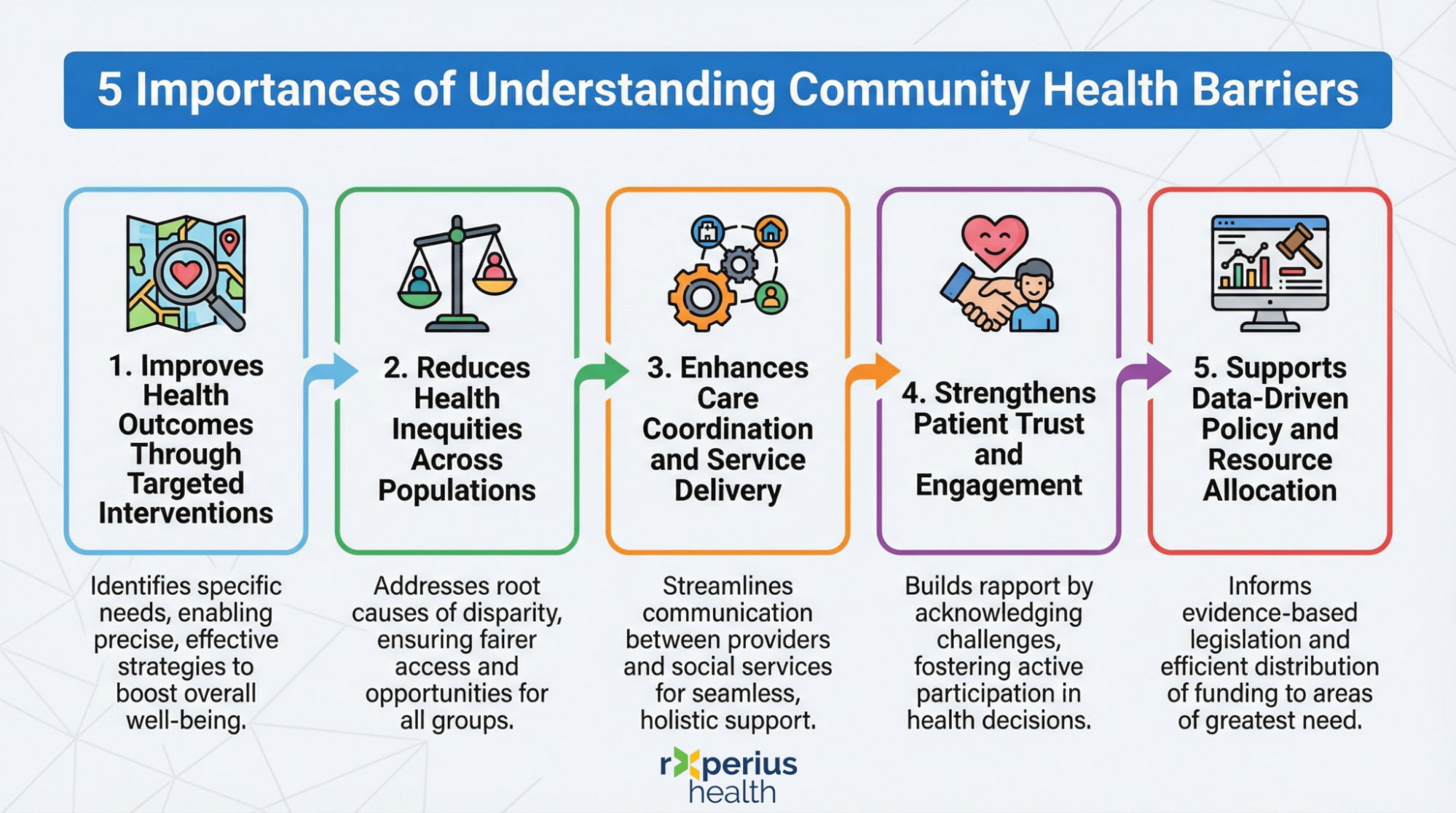
Recognition of community health barriers shifts healthcare from a reactive, treatment-focused model to a proactive, prevention-oriented approach. When healthcare systems understand their community’s specific challenges, they can redesign services to meet people where they are, rather than expecting patients to overcome complex barriers alone.
This understanding also enables healthcare organizations to form strategic partnerships that address root causes rather than just symptoms. By collaborating with transportation services, social service agencies, community organizations, and local businesses, healthcare providers can create support networks that strengthen the entire community’s health infrastructure.
Most importantly, barrier-aware healthcare delivery improves both patient outcomes and system efficiency by reducing emergency department visits, preventing complications from untreated conditions, and building trust that encourages regular engagement with preventive care services.
Measuring Success: How to Know Your Barrier-Focused Interventions Work
Measuring the impact of barrier-reduction efforts requires looking beyond traditional clinical metrics to include community-level indicators that reveal whether interventions are actually working.
Competitor Insight Missed
Most organizations measure success through traditional clinical metrics, missing community-level indicators that reveal whether barrier interventions are actually working.
Practical Implementation
Track community-specific metrics like appointment attendance rates by zip code, medication pickup rates, and patient-reported outcome measures that capture social determinants improvements.
Success in addressing community barriers shows up in patterns of increased engagement, reduced emergency visits, and improved medication compliance—metrics that require intentional tracking and analysis.
Building Sustainable Solutions That Address Root Causes
Policy interventions, including Medicaid expansion, have improved preventive care utilization and reduced mortality, especially among non-Hispanic Black populations, highlighting the potential of targeted policy actions to address health disparities.
Building sustainable solutions requires moving beyond individual interventions to create systemic changes that improve community infrastructure. This means working with local government, businesses, and community organizations to address the social determinants that create health barriers in the first place.
Competitor Insight Missed
Many barrier-reduction efforts fail because they focus on individual interventions rather than systemic changes that create lasting community infrastructure improvements.
Practical Implementation
Develop multi-year community health improvement plans that involve local government, businesses, and community organizations. Create shared funding mechanisms that support long-term barrier reduction initiatives.
Sustainable change happens when healthcare organizations become active partners in community development, not just providers of clinical services.
Taking Action on Community Health Barriers
Understanding community health barriers isn’t just about being a better healthcare provider—it’s about fundamentally transforming how care gets delivered in your community. When you recognize that a missed appointment might signal transportation challenges rather than patient disinterest, you unlock the ability to create real solutions that work.
The barriers we’ve explored represent both obstacles and opportunities. Every barrier you identify and address creates a stronger, more accessible healthcare system that serves everyone more effectively. Start by choosing one barrier that affects your community most significantly, develop partnerships to address it, and measure your impact systematically.
Common Questions About Community Health Barriers
1. What specific data should healthcare organizations collect to identify community barriers?
Healthcare organizations should collect zip code-level health outcome data, patient demographic information, transportation patterns, insurance coverage gaps, and community asset mapping data to identify barriers effectively.
2. How can small healthcare practices address community barriers with limited resources?
Small practices can start by forming partnerships with one or two local organizations and focusing on one barrier at a time while measuring impact before expanding efforts.
3. What role should patients play in identifying and addressing community health barriers?
Patients should be central partners through advisory boards, surveys, and focus groups. Their lived experiences provide insights that data alone cannot reveal.