

Picture this: you’re drowning in paperwork, your staff is burning out from endless data entry, and patients are frustrated with wait times while your practice struggles to stay profitable. If this sounds familiar, you’re not alone.
In a seminal 2017 article in the Annals of Family Medicine, it was reported that primary care physicians spent over 50% of their workdays on their EHRs, which averaged about 4.5 hours per day in the clinic, and 1.5 hours after hours each day at home.
EHR software integrations are changing the game completely by connecting your systems and automating workflows to give you back precious time for patient care.
Why Your Current EHR System Is Actually Making Administrative Tasks Harder
Healthcare providers often discover that their standalone EHR system, despite promises of efficiency, creates more work than it eliminates. The reality is that most EHR implementations focus solely on digitizing existing paper processes without addressing the underlying workflow inefficiencies.
The problem becomes even more pronounced when you consider that the average medical practice uses 8-12 different software applications daily. Without proper EHR system integration, staff members become human bridges between systems, manually transferring data from scheduling software to billing platforms, from lab results to patient records, and from insurance verification tools to treatment documentation.
This fragmented approach not only wastes valuable time but also introduces multiple opportunities for errors that can compromise patient safety and practice revenue. Modern healthcare demands a connected ecosystem where information flows seamlessly between all touchpoints in the patient journey.
The practices that recognize this fundamental shift are the ones experiencing dramatic reductions in administrative overhead while simultaneously improving patient satisfaction scores and clinical outcomes. So what’s the solution to breaking free from this digital chaos?
10 Ways EHR Integrations Slash Administrative Burden
Smart EHR integration benefits transform your practice into a self-updating system where patient information flows automatically between connected platforms. Here’s how these powerful connections revolutionize your daily operations.
1. Automated Data Entry Eliminates Manual Input Tasks
Instead of staff manually entering lab results, appointment updates, or insurance changes across multiple systems, integrated workflows handle these tasks instantly and accurately. This automation particularly shines in high-volume areas like patient intake, where demographic information, insurance verification, and medical history can populate across all necessary systems with a single patient interaction.
The beauty lies in the elimination of human error while dramatically reducing the time staff spend on repetitive data entry tasks. AI assistants can reduce a physician’s time devoted to documentation by up to 70% by transcribing patient encounters, entering data into EHRs, and processing information for orders and prescriptions, allowing physicians to focus on direct patient care.
2. Real-Time Insurance Verification Stops Revenue Leaks
Traditional insurance verification involves multiple phone calls, website logins, and manual documentation that can take 15-20 minutes per patient. Integrated EHR systems connect directly with payer databases, providing instant eligibility verification, coverage details, and prior authorization status.
This real-time connectivity not only saves administrative time but also prevents the costly surprise of denied claims weeks after service delivery, protecting your practice’s cash flow and reducing patient billing disputes. Insurance verification is just the start – wait until you see how prior auth automation transforms your workflow.
3. Streamlined Prior Authorization Cuts Approval Times
Prior authorization traditionally requires staff to gather clinical documentation, complete multiple forms, and track submission status across various payer portals. Integrated systems automate this entire process by pulling relevant clinical data directly from patient records, auto-populating payer-specific forms, and providing real-time status updates.
Some advanced integrations even use AI to predict which services will require prior authorization based on patient history and payer policies, giving you a head start on approvals. But the real game-changer comes when lab and imaging results start flowing automatically.
4. Connected Lab and Imaging Systems Deliver Results Instantly
Manual result entry creates bottlenecks that delay patient care and consume significant staff time. When your EHR integrates with laboratory and imaging systems, results flow directly into the appropriate patient records the moment they’re available.
This integration includes automatic flagging of abnormal values, integration with clinical decision support tools, and instant notifications to relevant providers, ensuring critical results never get lost in administrative processes. Speaking of patient communication, integrated portals are revolutionizing how practices handle routine inquiries.
5. Unified Patient Communication Reduces Call Volume
Integrated patient portals connected to your EHR system enable patients to access test results, schedule appointments, request prescription refills, and communicate with providers without phone calls. These systems automatically update appointment confirmations, send medication reminders, and provide post-visit care instructions.
This dramatically reduces the administrative burden on front office staff while improving patient satisfaction through 24/7 access to their healthcare information. Revenue optimization is great, but billing automation can undo manual coding delays entirely.
6. Automated Billing Workflows Eliminate Coding Delays
Integrated billing systems pull procedure codes, diagnosis information, and patient demographics directly from clinical documentation, eliminating the need for manual charge entry. Advanced integrations include real-time claim scrubbing that identifies potential issues before submission and automatic correction of common coding errors.
Reduced Administrative Burden: RCM streamlines billing processes, minimizes errors, and optimizes administrative tasks, alleviating the daunting administrative burden on medical professionals. This automation allows healthcare providers to focus on delivering quality care. This seamless process reduces the time between service delivery and payment while minimizing costly claim rejections.
7. Smart Scheduling Integration Prevents Double-Bookings
Connected scheduling systems access real-time provider calendars, patient preferences, and clinical requirements to optimize appointment booking automatically. These integrations can predict optimal appointment lengths based on visit types, automatically reschedule when emergencies arise, and send personalized reminders that reduce no-show rates.
The system intelligence extends to resource allocation, ensuring rooms and equipment are available when needed without manual coordination. But what about accessing patient records from other providers?
8. Interoperable Health Information Exchange Eliminates Redundant Requests
When your EHR connects to regional Health Information Exchanges, you gain instant access to patient records from other healthcare providers, eliminating the need to request and manually enter historical medical information. This healthcare data integration provides a complete patient picture at the point of care.
This integration reduces duplicate testing and ensures continuity of care without administrative delays. Patients no longer need to carry paper records or remember complex medical histories, streamlining the entire care process.
9. Integrated Quality Reporting Automates Compliance Documentation
Quality measure reporting, required for programs like MIPS and value-based care initiatives, traditionally requires dedicated staff to extract and compile data from various sources. Integrated EHR systems automatically track quality metrics throughout patient encounters and generate required reports with a few clicks.
This automation ensures you never miss reporting deadlines while reducing the administrative burden of manual data compilation. The future of documentation is even more exciting with AI-powered tools.
10. AI-Powered Clinical Documentation Transforms Voice to Structured Notes
Advanced EHR integrations now include AI-powered documentation tools that convert natural speech into structured clinical notes, automatically assigning appropriate medical codes and extracting key clinical data points. These systems understand medical terminology, maintain proper documentation structure, and can suggest additional documentation elements.
This technology allows providers to focus on patient interaction while creating detailed, accurate documentation that supports both clinical care and billing requirements. Now let’s explore how to choose the right integration strategy for your specific needs.
Choosing the Right Integration Strategy for Your Practice Size and Specialty
The key to successful clinical workflow optimization lies in understanding that one size definitely doesn’t fit all in healthcare technology. Small primary care practices need different integration priorities than large multi-specialty groups or hospital systems.
Your integration strategy should align with your specific workflow challenges, patient volume, and growth projections. Start by conducting a workflow audit to identify where staff spend the most time on repetitive tasks, then prioritize integrations that address these high-impact areas first.
Consider your specialty’s unique requirements – a cardiology practice might prioritize device integrations for monitoring equipment, while a pediatric practice might focus on patient portal enhancements for parent communication. The most successful implementations begin with clear goals and realistic timelines.
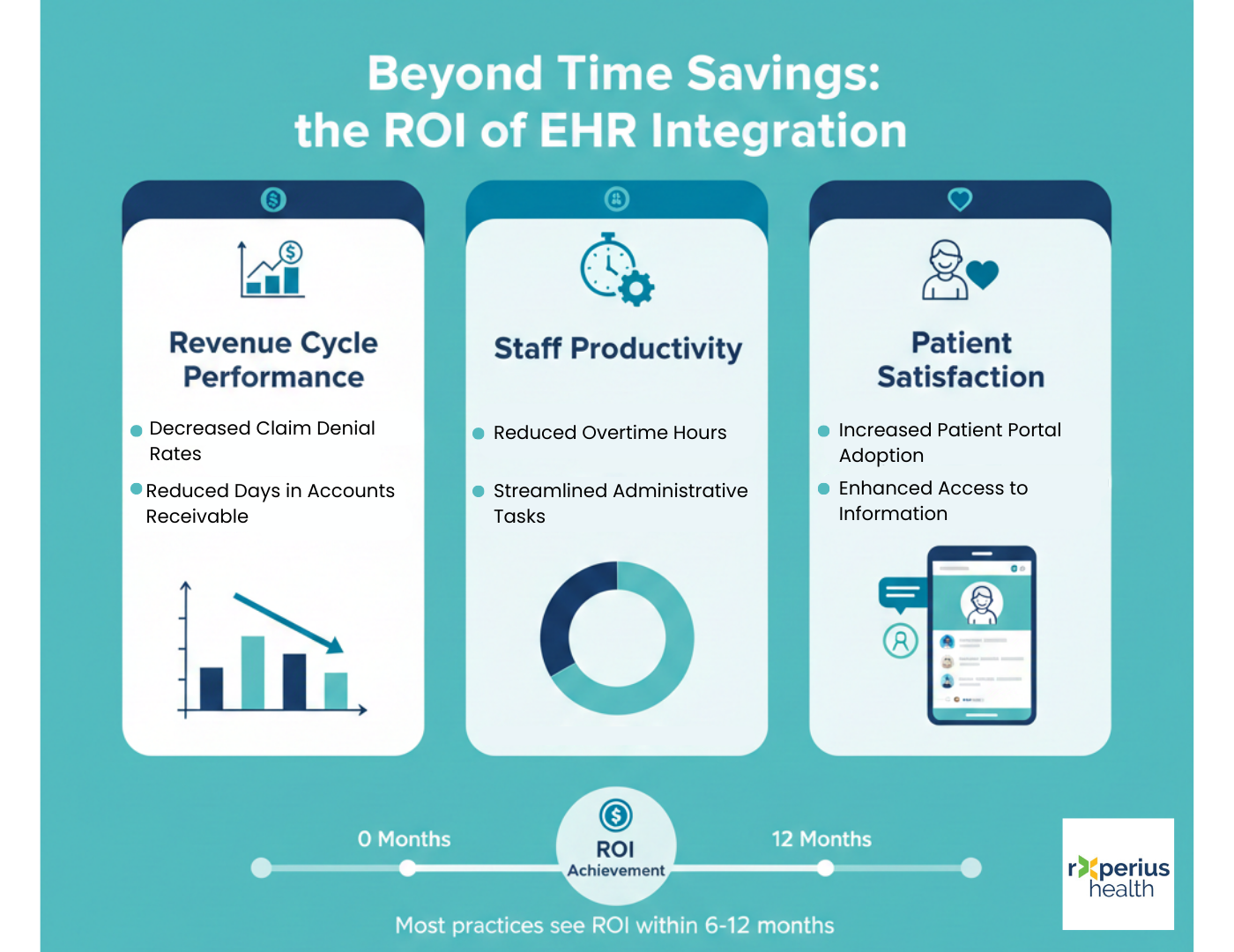
Measuring ROI: How to Calculate the True Impact of EHR Integrations
Future-Proofing Your Practice with Next-Generation Integration Technologies
The integration environment continues evolving rapidly, with emerging technologies like blockchain for secure data sharing, advanced AI for predictive analytics, and IoT devices for real-time patient monitoring. The integration of wearable devices and remote monitoring tools with EHR systems is on the rise, allowing for the continuous collection of real-time health data and facilitating proactive care interventions.
Understanding these trends helps you make integration decisions that will serve your practice well into the future, avoiding costly system replacements and ensuring your technology investment continues delivering value as healthcare evolves. Focus on platforms that prioritize open APIs and industry standards for maximum flexibility.
The practices investing in forward-thinking integration strategies today are positioning themselves as leaders in tomorrow’s healthcare environment. Now let’s address some common questions about EHR integrations.
Transform Your Practice Today
EHR software integrations aren’t just about connecting systems – they’re about reclaiming your practice’s efficiency and returning focus to patient care. By implementing strategic integrations that automate repetitive tasks, streamline workflows, and eliminate data silos, you can reduce administrative burden significantly while improving accuracy and patient satisfaction.
The key is starting with your biggest pain points, choosing reliable integration partners, and scaling your connected ecosystem gradually. Ready to transform your practice? Begin by auditing your current administrative workflows and identifying the top three time-consuming tasks that could benefit from automation.
Common Questions About EHR Software Integrations
1. What’s the difference between EHR integration and EHR interoperability?
EHR integration refers to connecting your primary EHR system with other software applications to share data and automate workflows. Interoperability is broader – it’s the ability for different healthcare systems to exchange, interpret, and use patient data regardless of the original system.
2. How long does it typically take to see administrative burden reduction after implementing EHR integrations?
Most practices begin seeing immediate benefits in specific workflows within 2-4 weeks of integration activation. Substantial administrative burden reduction typically occurs within 3-6 months as staff adapts to new workflows and all integrations reach full functionality.
3. Can EHR integrations work with legacy systems, or do I need to completely upgrade my technology?
Many modern integration platforms use APIs and middleware solutions that can connect with legacy systems, even those that weren’t originally designed for integration. However, very old systems may require custom development work or have limited integration capabilities.