

Patient data is everywhere, but useful answers still feel hard to find. A clinician is buried in alerts, an ops leader is juggling staff shortages, and a payer is trying to cut avoidable costs. Yet the insights stay scattered across EHRs, claims, labs, imaging, and wearable devices.
This guide covers what healthcare data analytics actually looks like in practice, what it measurably delivers, and where most projects quietly fail.
What Big Data Analytics in Healthcare Really Means
Most organizations mistake dashboards for analytics. Big data analytics in healthcare goes further.
It combines EHR data, claims, lab results, imaging, clinical notes, devices, and social determinants of health, then applies machine learning, NLP, and predictive models to generate actionable insight, not just historical reports.
Value-based care contracts, workforce shortages, and remote monitoring programs are all producing more data faster than traditional reporting tools can handle.
|
Before You Build: Write one sentence defining the job to be done: “Reduce 30-day readmissions by 10% by improving post-discharge outreach targeting.” If you can’t state that clearly, don’t build yet. |
Healthcare Big Data vs Regular Medical Data
Healthcare big data differs from standard clinical data across four key dimensions.
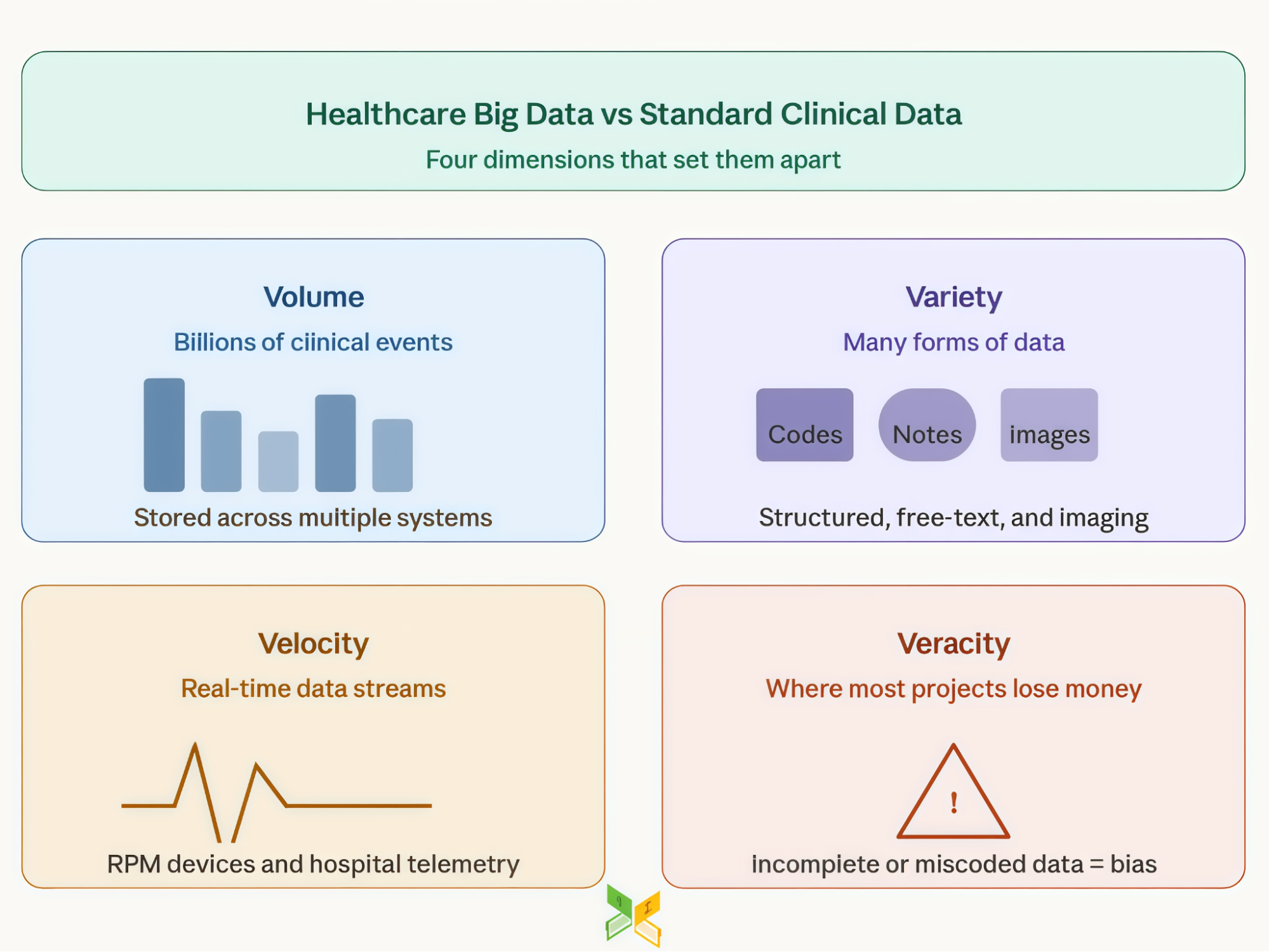
- Volume – Billions of clinical events stored across systems.
- Variety – Structured codes, free-text notes, and medical images.
- Velocity – Streaming data from RPM devices and hospital telemetry.
- Veracity – Where most projects quietly lose money. Incomplete, miscoded, or outdated data produce biased models and erode clinician trust.
|
Action Item: Start tracking three metrics per data source: missingness rate, timeliness, and coding consistency. |
The Biggest Benefits of Big Data Analytics for Healthcare
The benefits of big data in healthcare span clinical, operational, financial, and research outcomes. Each use case below is measurable, not theoretical.
Improve Clinical Decisions Without More Burden
Risk scoring and triage support work only when analytics are embedded into EHR workflows rather than delivered as separate emailed reports.
A care manager who receives a daily high-risk patient list inside their existing system is far more likely to act than one who opens a separate tool. A sepsis risk model that surfaces deteriorating patients directly in the EHR chart is one practical example of this working.
Catch Deterioration Earlier With Remote Monitoring
Wearables and RPM devices for CHF and COPD generate continuous data streams that spot decline before a patient reaches the ED.
The key is alert governance: every alert type needs a defined owner, a response threshold, and a clear escalation path before going live.
Reduce Costs by Removing Invisible Waste
Data and analytics can play a significant role in improving efficiency and reducing unnecessary healthcare spending when applied effectively.
Much of that savings comes from operational analytics, not clinical AI. No-show prediction models that trigger SMS reminders for high-risk patients are a low-tech example with measurable impact on no-show rate, length of stay, and duplicate imaging.
Make Population Health Actionable
Population analytics fails when it stops at risk stratification. The real value comes from turning a risk score into a prioritized outreach list that a care manager can work through that day.
Adding two or three reliable SDOH fields, such as housing instability or transport access, improves targeting significantly when paired with solid data quality checks.
Organizations applying analytics to patient-reported outcomes and quality-of-life measures are seeing better targeting and engagement, especially when paired with structured solutions like QoL healthcare analytics platforms.
Speed Up Research and Precision Medicine
Real-world evidence studies and cohort discovery both depend on knowing where the data came from and how it was transformed. A simple “dataset passport” capturing source, refresh rate, and known limitations cuts weeks off project setup.
Any genomics-based precision medicine model needs a bias and coverage review to confirm which patient populations are missing from training data.
Also read: Healthcare Data Analytics Improving Patient Outcomes
The Hard Part: Challenges That Break Big Data Projects
Most healthcare predictive analytics failures are organizational, not technical. Research confirms that data privacy, technical complications, and expertise gaps are the three primary barriers to adoption.
Understanding all three before you build is what separates programs that scale from those that stall.
Data Quality and Interoperability Problems
Missing fields, duplicate patient identities, and inconsistent coding corrupt outputs before they reach a clinician. Master Patient Index fixes often need to happen before any ML work begins.
By 2021, 96% of non-federal acute hospitals had adopted a certified EHR, up from just 28% in 2011.
The issue is no longer whether data exists digitally; it is whether it flows across systems without quality loss. Data rights and vendor contracts are frequently the real blocker, not the technology.
Privacy, Bias, and Workflow Adoption
HIPAA and GDPR protect PHI, but de-identification alone is not a complete shield. Re-identification risk is real for patients with rare conditions. Role-based access, audit logs, and a “no local downloads” policy are practical starting points.
Bias adds another layer: many models optimize for cost rather than care quality, quietly under-triaging underserved patients. Subgroup performance reviews by race, language, and payer type should be required before any model goes live.
|
Adoption Warning: Workflow adoption is where most programs die after launch. Design for one specific role at a time. Make recommended actions available in two clicks; this dramatically improves uptake. |
A Practical Roadmap for Starting Big Data Analytics
The goal here is a workable starting framework, not a perfect program. Pick a use case that is costly, frequent, improvable, and supported by available data. Operations and care management are often better first choices than radiology AI.
- Pick one high-impact, well-defined use case. Operations and care management are often better starting points than radiology AI.
- Map your data sources on one page: document each source’s owner, refresh rate, and quality risks.
- Define “good enough” thresholds, for example, under 5% missingness on key fields, before building anything.
- Put lightweight governance in place: an intake form, PHI classification, and a named approver.
- Pilot in a single unit for six to eight weeks, measuring against predefined metrics.
- Never transfer a model to another site without local re-validation first.
Emerging Trends Worth Watching Now
As healthcare data matures, the focus is shifting from adoption to trust, scalability, and sustained performance.
Privacy-Preserving Analytics and Explainable AI
Federated learning lets multiple hospitals train shared models without moving raw patient data, making multi-site collaboration under tighter privacy rules a realistic option for readmission and sepsis models.
Explainable AI gives clinicians reason codes and top contributing factors rather than black-box scores, which is increasingly a regulatory and patient safety requirement as well.
Continuous Model Monitoring
“Set it and forget it,” AI is unsafe in healthcare. Performance metrics need to be tracked over time, and a defined drift threshold should automatically trigger a review.
A simple “AI time-out” rule, where a model falling below a performance threshold reverts to the baseline workflow, is the minimum safety net every deployed model needs.
|
Dimension |
BI Reporting |
Predictive Analytics |
AI and ML Models |
|
Primary output |
Historical dashboards |
Risk scores, forecasts |
Automated recommendations |
|
Data sources |
Structured EHR, claims |
EHR, claims, labs, devices |
Multi-modal: genomics, imaging, notes |
|
Update frequency |
Daily or weekly |
Near real-time |
Continuous |
|
Key risk |
Data lag |
Model bias |
Drift, re-identification |
|
Governance need |
Data access policies |
Validation, fairness review |
MLOps, explainability, monitoring |
Final Thoughts on Big Data Analytics in Healthcare
Big data analytics in healthcare delivers real value only when data quality, privacy, fairness, and workflow adoption are treated as first-class requirements from the start.
The evidence base is strong, the digital infrastructure is largely in place, and the use cases are well-defined. Start with one high-impact, measurable problem, validate it locally, and build governance before you need it.
Download our use-case prioritization checklist or book a discovery call to move your first use case into a working pilot within 60 days.
Common Questions About Big Data Analytics in Healthcare
What is big data analytics in healthcare in simple terms?
It combines large amounts of clinical, operational, and patient data from multiple sources and analyzes it with statistical or ML methods to improve care decisions, reduce costs, and identify health risks before they escalate.
What are the main benefits for patients and providers?
Patients get earlier diagnoses, fewer duplicate tests, and more targeted treatments. Providers get better decision support, less operational waste, and population health data that connects directly to actionable workflows.
What are the biggest challenges?
Data privacy requirements, poor data quality, fragmented systems, skills gaps, and workflow adoption issues are the most widely documented barriers. Most projects fail due to organizational factors, not purely technical ones.
How can a hospital practically start with big data analytics?
Pick one high-impact, well-defined use case. Map data sources. Set quality thresholds. Build lightweight governance. Pilot in one unit for six to eight weeks. Scale only after confirming workflow adoption and measuring outcomes.
How are AI and machine learning used with big data in healthcare today?
NLP processes clinical notes, imaging models detect abnormalities, risk models flag readmission or sepsis candidates, and forecasting tools manage staffing and capacity. All require local validation, ongoing monitoring, and workflow integration to be effective.