

The waiting room is overflowing, your EHR inbox is a mountain of unread messages, and your staffing schedule is stretched to the breaking point. It’s a cycle many clinical leaders know all too well: chronic patients frequently rebounding to the ED and critical follow-ups slipping through the cracks. When you’re drowning in data but starved for time, it can feel like you’re working harder just to stay in place.
With 70% of global health systems prioritizing IT modernization, the pressure to adopt new technology is higher than ever. However, simply adding “more tech” isn’t the solution—the goal is identifying the right digital health solutions. This guide breaks down which tools actually drive clinical outcomes, how to implement them without overwhelming your team, and how to measure true success.
Digital Health Solutions That Actually Improve Patient Outcomes
Not every tool delivers results. The gap between buying a platform and seeing clinical impact is wide, and most organizations fall into it. The fastest path to outcomes is picking one metric you want to move and choosing a solution that directly targets it within 60 to 90 days.
|
Outcome |
Digital Tool |
Key Workflow Change |
Key Metric |
|
Reduce readmissions |
Remote patient monitoring (RPM) |
Nurse-led alert triage |
ED visits, 30-day readmissions |
|
Improve BP control |
Connected BP cuff + portal nudges |
Automated follow-up loop |
BP control rate, portal activation |
|
Cut no-shows |
Telehealth + pre-visit intake |
Hybrid scheduling by visit type |
No-show rate, time-to-appointment |
|
Boost adherence |
Medication reminder tools |
Refill synchronization |
PDC/MPR ratio |
|
Reduce documentation burden |
AI ambient documentation |
Draft summary with human review |
Time in EHR, after-hours charting |
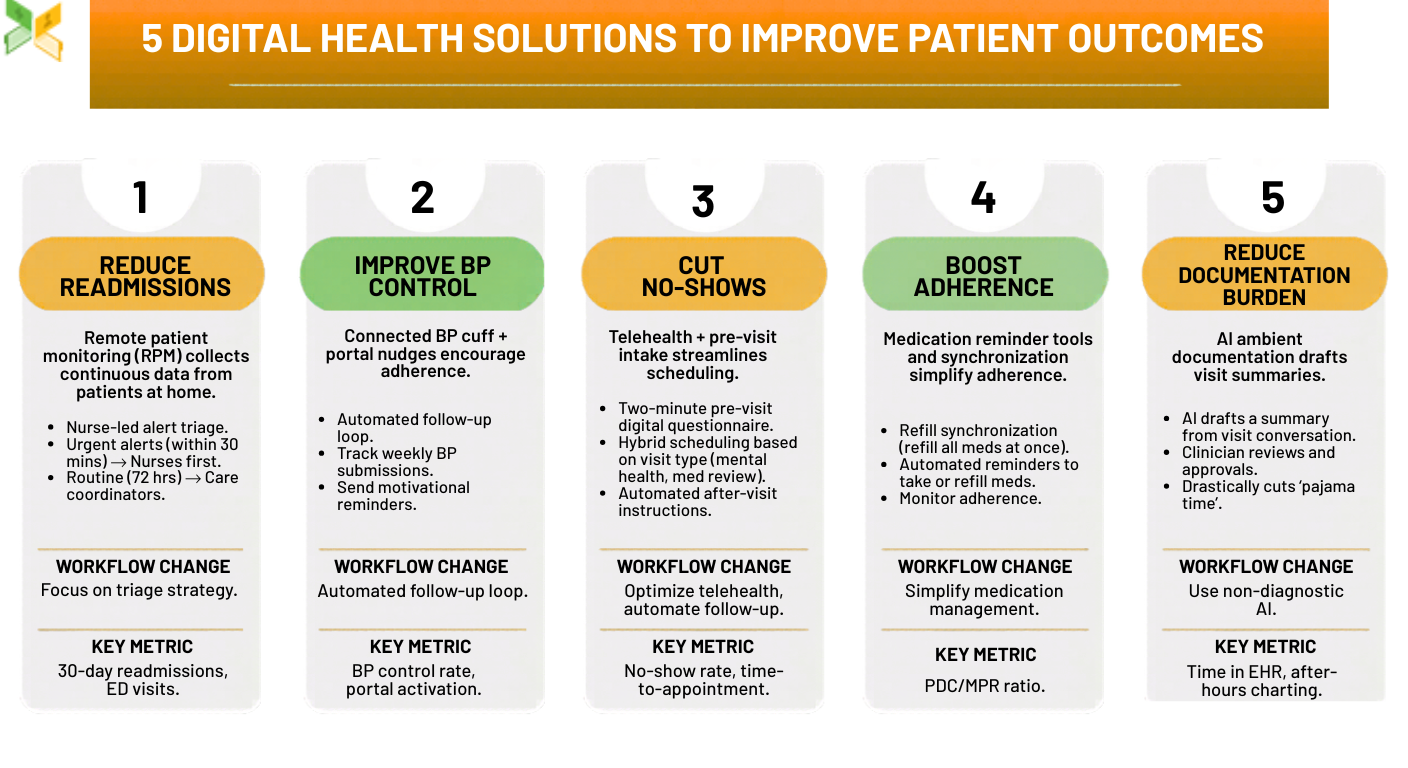
Fix the Between-Visits Gap with Remote Patient Monitoring
Remote patient monitoring (RPM) collects continuous data from patients at home and routes it to your care team for review. It works for hypertension, CHF, COPD, and diabetes.
The challenge isn’t the technology; it’s alert fatigue. If you don’t cap alerts per clinician, your RPM program will fail regardless of how good the devices are. Set three tiers: urgent (review within 30 minutes), soon (same business day), and routine (within 72 hours).
Route urgent alerts to nurses first, not physicians. That single workflow change is often what separates a program that improves outcomes from one that gets abandoned.
Make Telehealth Work Around the Visit Type
The telehealth market is expected to exceed $455 billion by 2030, representing over 369% growth since 2024. That scale only benefits your patients if the design is right. Generic video links don’t improve outcomes.
What does it build: a two-minute digital pre-visit questionnaire, a visit type that matches the clinical need (follow-up, mental health, medication review), and automated after-visit instructions with a seven-day follow-up message. If you can’t show today whether your telehealth visits improved no-show rates or just shifted volume, you’re flying blind.
Turn the Patient Portal Into a Next Best Action Hub
Most portals are passive. Patients log in, download a document, and leave. That’s not engagement. Aim for 70 to 80% portal activation in your chronic disease population and back it with three automated nudges: overdue screenings, medication refill reminders, and post-lab follow-up prompts. Portals that push “next best action” content see lower inbound call volume and better adherence. They also reduce the friction that drives missed care.
Use AI to Cut Workload Before Going Clinical
Digital transformation has led 65% of U.S. hospitals to use AI-assisted predictive tools embedded in their EHR systems.
But starting with clinical AI is a mistake most organizations regret. Start with non-diagnostic AI instead: ambient documentation that auto-drafts visit summaries, inbox triage that categorizes patient messages by urgency, and prior authorization support. Outcome gains often come indirectly through reduced clinician burnout and faster response times. Once that foundation is stable, layer in risk stratification and decision support.
Connect Data Where It Actually Shows Up in Workflow
According to the World Economic Forum, hospitals now produce the equivalent of 2.3 trillion DVDs of data each year, yet 97% of that data remains unused. The opportunity isn’t more data; it’s surfacing the right data at the right moment.
FHIR (Fast Healthcare Interoperability Resources) compatibility matters only if it puts information inside the chart where clinicians actually work. Start with one integration win: pull RPM vitals into a single flowsheet and create an at-a-glance trend view. That’s more valuable than a sprawling data warehouse that nobody opens.
Picking the right tools is only half the challenge. How you roll them out determines whether they stick or become shelfware.
Implementation That Sticks Without Burning Out Clinicians
As the global healthcare worker shortage reaches 10 million by 2030, ongoing IT modernization can also support workforce needs. That number should change how your team thinks about digital programs. Every new tool that adds work without removing work is a retention risk.
Start with one outcome, one population, and one workflow. Say no to scope creep early. Before go-live, run a 60-minute workflow mapping session with frontline staff and remove at least two existing steps. A tool that removes work gets adopted; a tool that adds a dashboard to an already full screen does not.
Write SLAs for accountability from day one: urgent alerts resolved in under 30 minutes, routine messages within 24 hours. Then build a super-user bench. Identify one champion per unit, give them weekly office hours and a direct feedback loop to IT, and train for behavior change rather than feature clicks. That combination, focused scope plus workflow redesign plus clear ownership plus behavior-focused training, is what separates programs that improve outcomes from programs that generate activity reports.
Measuring Impact Beyond Activity Metrics
High portal logins don’t improve A1c. Engagement metrics and outcome metrics are not the same thing, and conflating them will cause you to lose leadership confidence in your digital health solutions and healthcare investments.
Define two leading indicators (weekly BP submissions, medication refill rates) and two outcome indicators (BP control rate, ED visits). Set a baseline before launch using a phased rollout or matched cohort so you can defend real improvement, not just post-launch trends. Then quantify the clinician time saved. Track documentation time and after-hours charting before and after. Capacity is the currency that unlocks sustainability for any digital program.
Choosing the Right Digital Health Solution
Selecting a digital health platform is often a multi-million dollar decision. To avoid “shelfware”—software that is purchased but never used—evaluate every potential vendor against these four core pillars:
- Clinical Evidence: Requires more than just marketing claims. Demand published trial data, peer-reviewed studies, or verified real-world outcome benchmarks from organizations similar to yours.
- Integration Reality: Do not accept a “FHIR-compatible” label at face value. Insist on a live demonstration using your specific data elements within your existing EHR environment to ensure it surfaces where clinicians actually work.
- Total Cost of Ownership (TCO): Model the “hidden” costs, specifically staffing time. Calculate the required monitoring hours per 100 patients per month; if you exclude human labor from your ROI projections, the model will likely collapse post-launch.
- Workflow Fit: Avoid “flagship” bias. Ask for references from healthcare systems of your specific size and complexity. A tool that works for a university hospital with a massive IT team may fail in a lean, community-based practice.
Turn One Outcome Into a 60 to 90 Day Win
Digital health solutions improve patient outcomes when they’re tied to a specific clinical goal, embedded in real workflows, measured with the right metrics, and designed with trust and equity as non-negotiable constraints.
Pick one outcome you want to move this quarter, whether that’s readmissions, BP control, no-shows, or medication adherence. Choose one digital health solution in healthcare that targets it directly, and run a 60 to 90-day pilot with clear baselines and a simple dashboard. Anything more complex is likely to stall before it delivers.
Common Questions About Digital Health in Healthcare
What are digital health solutions?
Technologies designed to improve health outcomes through data and connectivity. This includes Telehealth, EHRs, wearable sensors, and mHealth apps that bridge the gap between clinic visits and daily life.
How to scale digital health solutions?
Move from pilot to platform by ensuring interoperability (systems talking via FHIR), securing sustainable reimbursement, and automating routine tasks so staff can focus on high-risk patients.
What are the solutions in digital health and wellness?
Digital health typically refers to clinical tools used to treat or manage conditions (like glucose monitors). “Digital wellness” focuses on prevention and lifestyle management (like stress-reduction apps).
How do digital health solutions empower users?
They shift patients from passive observers to active participants. Providing real-time access to lab results and personalized health trends gives patients the agency to manage their own chronic conditions.
How do we prove the ROI of a digital health solution?
Look at Capacity as Currency. Measure the reduction in “pajama time” (after-hours charting), the decrease in 30-day readmissions, and the capture of new reimbursement streams for tech-enabled care coordination.