

Picture this: You’re watching your hospital’s emergency room overflow while beds sit empty upstairs because there’s no real-time data about patient flow.
Over the past decade, big data analytics in healthcare has surged by an incredible 568%, yet most facilities still make critical decisions with outdated information.
Real-time data analytics is transforming this reality by providing healthcare professionals with the instant insights they need to save lives and improve care.
Real-Time Data Is Reshaping Modern Healthcare
Healthcare generates staggering amounts of information, over 2.3 Zettabytes every single day. But here’s the problem: most of that data sits in silos, unused, while hospitals continue making critical decisions based on yesterday’s reports.
Why Real-Time Data Matters
Real-time data changes this picture. Instead of waiting hours or days for insights, providers get actionable information the moment it’s needed, whether it’s:
- Alerting a nurse to a patient’s declining vitals.
- Helping administrators spot and prevent bottlenecks before they disrupt care.
This shift marks one of the biggest transformations since electronic health records first appeared. Unlike traditional analytics that only look backward, real-time analytics in healthcare creates a living snapshot of what’s happening right now, and what’s likely to happen next.
Real-Time Data Is More Than Just Technology
Real-time data analysis isn’t only about speed or numbers. It’s about changing how healthcare professionals think and act.
- Moving from reactive to predictive care.
- Anticipating problems instead of just responding.
- Creating space for innovation that directly improves patient care.
Connecting the Entire Healthcare System With Real-Time Data
What makes this transformation powerful is integration. When your:
- Electronic health records,
- Medical devices,
- Staff scheduling systems, and
- Supply chain platforms
…all communicate instantly, you build a healthcare ecosystem that’s more:
- Responsive (faster decisions).
- Efficient (less waste, better workflows).
- Human-centered (patients get attention when it matters most).
10 Ways Real-Time Data Transforms Healthcare Delivery
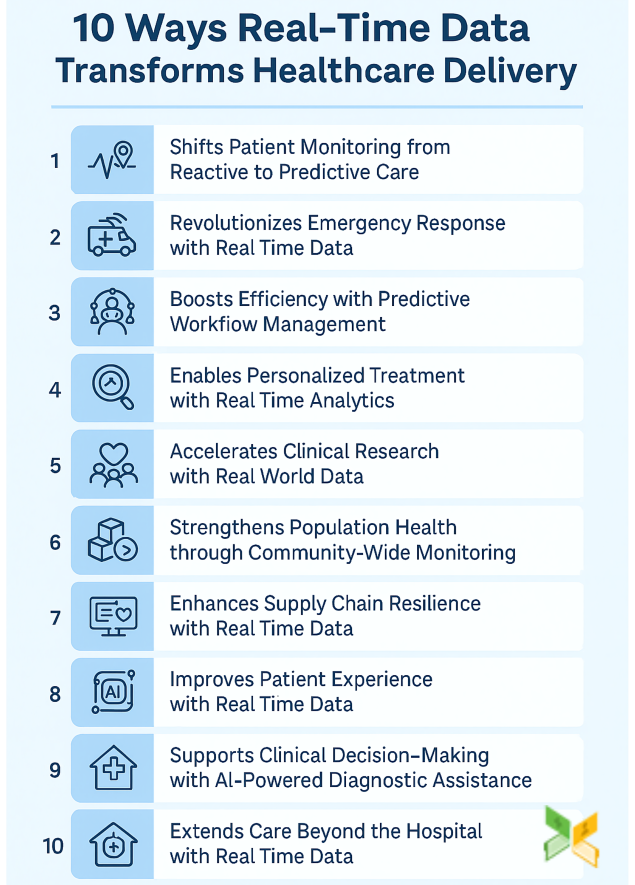
Transforms Patient Monitoring from Reactive to Predictive Care
Real-time patient data monitoring utilizes continuous streams from wearables, implants, and hospital sensors to predict health issues before they become critical.
- Beyond vitals: predictive biomarkers can detect sepsis 6 hours earlier than standard methods.
- Smart beds: track movement patterns to prevent falls.
- Glucose monitors: adjust insulin pumps automatically, without patient input.
The key is simple: predictive monitoring works best when you build baseline patterns for each patient, not just population averages.
This personalized approach to health data analytics creates a safety net, catching problems early, giving families peace of mind, and reducing costs.
2. Revolutionizes Emergency Response Through Instant Coordination
Real-time data helps emergency departments coordinate instantly across teams and facilities. For example:
- Ambulances send patient data while en route.
- Hospitals prep surgical teams, order blood, and alert specialists before arrival.
- Stroke patients get treatment 18 minutes faster on average.
The breakthrough: Real-time resource optimization. Predictive algorithms analyze staffing, historical patterns, and incoming ambulance data to adjust capacity. If real-time data analytics predicts a surge in trauma cases, say from weather conditions, the system can:
- Call in off-duty staff automatically.
- Delay non-urgent procedures to free up resources.
How to start: connect ambulance data feeds directly to your hospital’s resource management system. In emergencies, every minute saved can mean a life saved.
3. Optimizes Operational Efficiency Through Predictive Workflow Management
Real-time data analysis turns hospital operations from reactive and chaotic into smooth and predictable. Sensors can track patient flow, equipment location, staff movement, and supply levels, giving hospitals a complete picture of what’s happening.
Take Kaiser Permanente as an example. By sharing data across all its facilities, it reduced office visits and lab tests while improving patient outcomes. That’s the power of predictive workflow optimization. Instead of wasting time searching for wheelchairs or X-ray machines, hospitals can use real-time location systems to anticipate needs before shortages happen. The results can be huge.
Start small: track your most frequently misplaced equipment first, then expand. The payoff comes quickly.
4. Enables Personalized Treatment Through Continuous Health Analytics
Healthcare data analytics now allows treatments to adapt moment by moment, instead of relying only on periodic check-ups. Continuous monitoring of biomarkers, medication levels, and patient-reported outcomes builds a dynamic treatment profile that changes as conditions do.
- By combining genetic data with real-time analytics in healthcare, providers can predict drug effectiveness and potential side effects before they occur.
- Example: oncology patients wear devices that track how their bodies process chemotherapy in real time, letting oncologists adjust dosages immediately. This approach cuts adverse reactions and improves treatment effectiveness.
How to start: focus on patients with chronic conditions or complex medication regimens, groups that benefit most from continuous monitoring.
5. Accelerates Clinical Research Through Real-World Evidence Collection
Real-world data analytics is speeding up clinical research by moving beyond slow, costly trials in controlled environments. Now, evidence can be collected from millions of patients in real-world settings, showing how treatments work across diverse populations.
Adaptive clinical trials: Protocols adjust in real time as new data comes in.
- If a subgroup responds well, the trial automatically enrolls more similar patients.
- FDA pilot programs using this method cut drug development time significantly.
How healthcare systems can join: partner with research organizations to share anonymized patient data. This improves treatments and can also generate new revenue streams.
6. Strengthens Population Health Through Community-Wide Monitoring
Real-time population health monitoring pulls data from hospitals, clinics, pharmacies, schools, and even social media to spot health trends as they emerge. With this broad view, public health teams can respond faster to:
- Outbreaks,
- Chronic disease clusters, and
- Environmental health threats.
The game-changer: predictive outbreak modeling. By combining traditional surveillance with non-traditional sources, like social media sentiment, pharmacy sales, and Google search trends, communities can detect problems 5–7 days earlier than clinical testing alone.
How to start: build data-sharing agreements between local providers and public health departments, beginning with emergency department syndromic surveillance. Done right, health data analytics at the population level saves lives and prevents costly outbreaks.
7. Enhances Supply Chain Resilience Through Predictive Inventory Management
Real-time data analytics helps healthcare organizations avoid shortages and overstock by tracking usage patterns, supplier performance, and demand in real time. Smart inventory systems can now predict needs based on patient numbers, seasonal trends, and even local events.
Start simple: Set up automated reordering for your most-used items, then expand to predictive algorithms. With real-time data guiding decisions, supply chain disruptions don’t have to put patient care at risk.
8. Improves Patient Experience Through Proactive Communication Systems
Real-time data helps hospitals catch and resolve patient concerns early. Continuous feedback and predictive analytics flag issues before they turn into complaints or low satisfaction scores.
Smart systems use sentiment analysis to monitor patient interactions. If signs of dissatisfaction appear, the system alerts staff to respond with personalized outreach. Hospitals using this approach have seen satisfaction scores rise and complaint resolution times drop from days to hours.
How to start: Connect your patient communication platforms with analytics tools that track emotional indicators in real-time analytics in healthcare.
9. Supports Clinical Decision-Making Through AI-Powered Diagnostic Assistance
Real-time data analysis powers AI diagnostic assistance that analyzes patient information continuously and alerts clinicians to patterns they might miss, potential drug interactions, or diagnostic possibilities they haven’t considered. These systems serve as intelligent second opinions that never sleep, reviewing thousands of data points simultaneously.
The cutting-edge development is multimodal AI that combines real-time lab results, imaging, patient history, and even environmental factors to suggest diagnoses and treatments. At Johns Hopkins, an AI system analyzing real-time patient data correctly identified sepsis cases 6 hours earlier than traditional methods, with 18% fewer false alarms.
The key is making sure these systems support rather than replace clinical judgment; they should present options and evidence, not make final decisions. Begin by implementing AI assistance for your most common diagnostic challenges, gradually expanding as staff become comfortable with the technology.
10. Facilitates Remote Care Through Continuous Patient Engagement
Real-time data platforms let providers stay connected with patients at home, tracking chronic conditions, medication adherence, and recovery progress without frequent office visits.
- Remote monitoring has cut hospital readmissions and improved patient satisfaction.
- Tools include wearables, smartphone apps, and home monitoring devices linked to clinical oversight.
- When concerning trends appear, providers can adjust medications, recommend lifestyle changes, or arrange urgent care immediately.
How to start: focus on high-risk patients (e.g., heart failure, diabetes), then expand to other chronic conditions as capacity grows. Healthcare data analytics makes continuous, proactive care possible anywhere.
Comparing Real-Time Data Systems vs. Traditional Healthcare Data Systems
|
Aspect |
Traditional Data Systems |
Real-time Data Systems |
|
Decision Speed |
Hours to days for insights |
Instant alerts and recommendations |
|
Cost Impact |
Higher due to reactive care |
30-40% reduction through prevention |
|
Patient Outcomes |
Treatment after symptoms appear |
Predictive interventions before a crisis |
|
Staff Efficiency |
Manual data gathering and analysis |
Automated monitoring and reporting |
|
Supply Management |
Reactive ordering, frequent shortages |
Predictive inventory, 94% availability |
|
Emergency Response |
Delayed coordination |
18-minute faster treatment times |
|
Patient Satisfaction |
Standard care experience |
23% improvement through proactive care |
|
Research Capabilities |
Limited to historical analysis |
Dynamic, adaptive clinical trials |
Common Questions About Real-time Healthcare Data
1. What’s the difference between real-time data and regular healthcare analytics?
Traditional analytics looks backward at historical patterns, while real-time data provides insights the moment information is generated, allowing immediate action rather than delayed reactions.
2. How much does implementing real-time data systems typically cost?
Implementation costs range from $50,000 for basic monitoring to $5 million for comprehensive solutions, but ROI typically appears within 18-24 months through reduced readmissions and improved efficiency.
3. Can real-time systems integrate with existing electronic health records?
Most modern platforms integrate with major EHR systems through APIs and HL7 FHIR standards, though you’ll need IT infrastructure capable of handling increased data volume.
4. What happens if real-time systems provide false alerts?
Modern systems include validation mechanisms and machine learning that improve accuracy over time, plus customizable thresholds to minimize false positives while maintaining clinical judgment as the final authority.
5. How do we protect patient privacy with continuous data collection?
Real-time data systems must comply with HIPAA and other regulations through encryption, access controls, and audit trails, using techniques like differential privacy to analyze data without exposing individual information.
Turning Data Into Better Care
The shift to real-time data analytics is no longer optional; it’s the foundation of modern healthcare. From predicting emergencies to optimizing workflows, improving patient experiences, and strengthening population health, the evidence is clear: real-time insights save time, cut costs, and most importantly, improve patient outcomes.
Healthcare providers who act now will lead the transformation. Start small, whether in patient monitoring, supply chain, or emergency response, and scale as results build. Within months, you’ll see measurable improvements in efficiency, safety, and satisfaction.