

You know the feeling: a clinician needs complete patient information right now, finance needs clean numbers for value-based contracts, and IT is stuck reconciling five dashboards that don’t agree. The healthcare analytics market is projected to grow from USD 44.83 billion in 2024 to USD 133.19 billion by 2029, registering a robust CAGR of 24.3%. This explosive growth reflects how critical unified data has become for modern care delivery.
What a Modern Healthcare Data Platform Really Means
A modern healthcare data platform isn’t just another analytics tool or cloud storage solution. It’s a unified healthcare system that brings together clinical, administrative, and claims data from across your organization into one trusted source. Think of it as the foundation that makes every other digital health initiative possible.
A Quick Reality Check: EHR Reporting is Not Equal to an Enterprise Data Platform
Your EHR’s built-in reporting might handle basic clinical metrics, but it can’t pull together data from imaging systems, supply chain, call centers, and external partners.
Most EHR analytics struggle with the depth needed for complex decisions like risk adjustment, population health management, or AI-powered clinical insights. You need something that connects all your data sources, not just what lives inside your electronic health records.
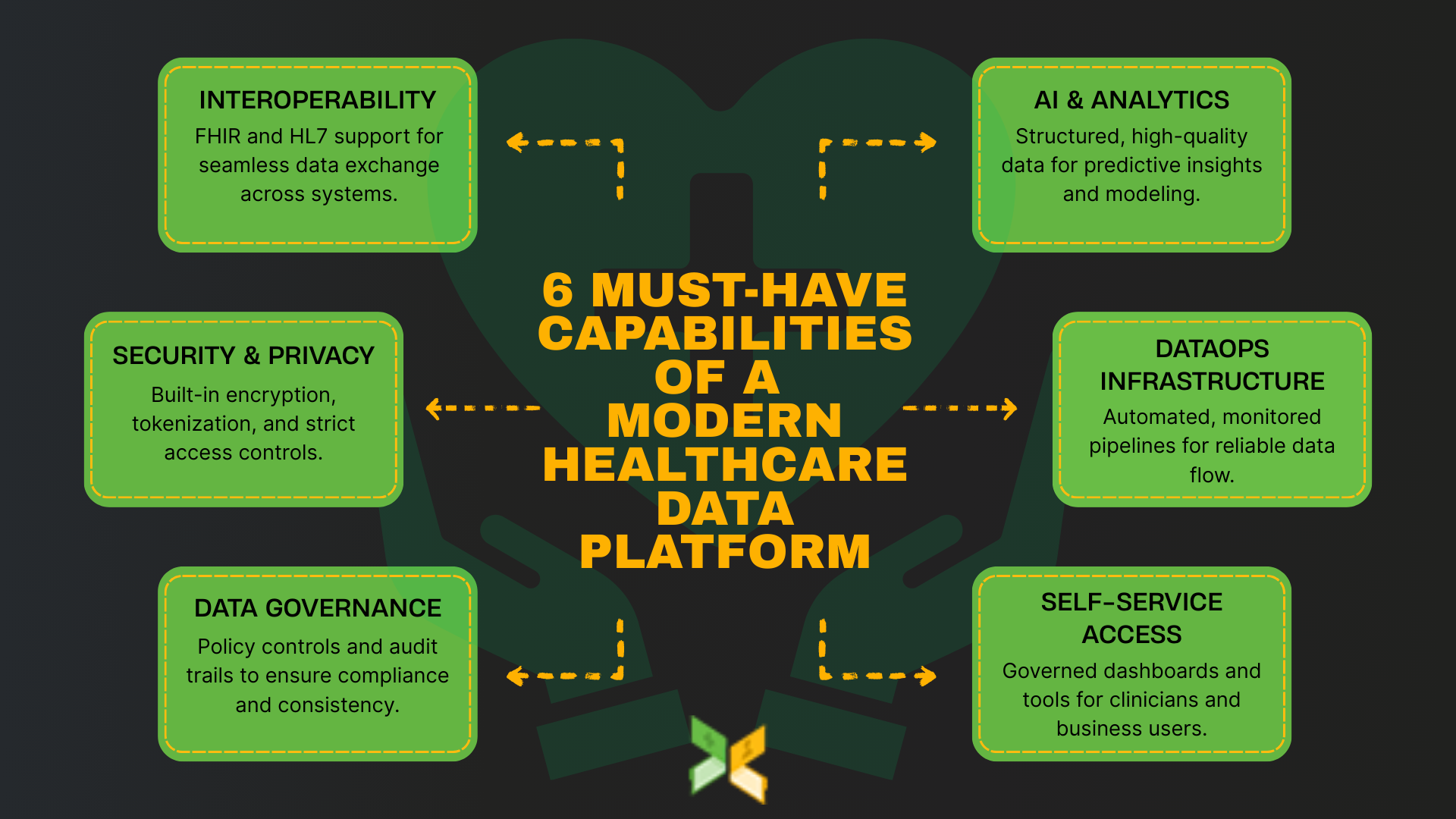
The 6 Must-Have Capabilities
A modern healthcare data platform must include the following six capabilities:
The Hard Costs of Outdated Data Systems
Legacy data systems create hidden costs that show up across your organization in ways you might not expect. When teams spend hours reconciling reports that should match but don’t, when prior authorizations get delayed because records are incomplete, and when staff burn out from manual data entry, you’re paying the price of outdated infrastructure.
Where Legacy Platforms Hurt Clinical Operations
Emergency departments face delays when bed management systems don’t talk to ADT feeds. Clinicians waste precious time hunting for patient medication histories across disconnected systems. Care coordination suffers when outside records, social determinants of health data, and pharmacy fill information remain invisible to your care teams, leading to incomplete clinical pictures when decisions matter most.
Where Legacy Platforms Hurt Revenue Plus Contracting
Denial rates spike when documentation signals get lost between systems. Risk adjustment and HCC capture become inconsistent without unified patient data. Value-based care reporting lags behind because manual processes can’t keep pace with contract requirements.
Data privacy and security concerns remain top priorities, with protecting sensitive patient data and complying with stringent regulations like HIPAA and GDPR creating ongoing challenges.
Understanding these costs makes the business case clear, but what happens when you modernize your data foundation?
What You Unlock with a Modern Data Platform
A unified healthcare data platform transforms how your organization operates, shifting from reactive problem-solving to proactive, insight-driven care. Healthcare providers hold the largest market share in analytics adoption, followed by payers and pharmaceutical companies leveraging these tools for clinical trials, market access strategies, and drug utilization studies.
Real-Time, Trusted Patient Context
When your platform unifies patient identity across all systems through enterprise master patient index technology, clinicians get complete, accurate patient stories. Real-time data feeds from labs, imaging, and external sources mean care teams can act on current information rather than yesterday’s snapshots. Trust comes through data lineage tracking that shows exactly where information originated and how it was processed.
Faster Throughput and Smarter Capacity Decisions
Predictive models powered by unified data help forecast patient length of stay and identify discharge barriers before they become problems. Operating room utilization improves when scheduling systems access real-time equipment status and staffing data.
The rise of real-time analytics through IoT devices and 5G connectivity enables instant data analysis, improving clinical decision-making and patient monitoring.
AI That’s Safe to Deploy
Modern platforms provide the governance foundation AI needs to work safely in healthcare settings. Model registries track AI tool performance while audit logs ensure accountability.
PHI redaction and prompt logging for generative AI tools protect patient privacy while enabling innovation. Without this foundation, AI projects often stall due to compliance concerns or data quality issues.
The benefits are clear, but choosing the right technical approach requires careful consideration of your organization’s specific needs.
Architecture Choices for Your Health System
Your platform architecture determines how quickly you can adapt to new needs and how efficiently your system performs under pressure. Cloud-based solutions dominate due to scalability, cost-effectiveness, and ease of integration.
Lakehouse vs Warehouse vs FHIR-First Platform
Data warehouses excel at structured reporting and financial analytics but struggle with unstructured clinical notes and imaging data. Lakehouses handle both structured and unstructured data cost-effectively, making them ideal for AI and machine learning workloads. FHIR-first platforms prioritize interoperability but still need traditional analytics patterns for operational reporting and research.
Hybrid and Multi-Cloud in Healthcare
Single-cloud strategies with governed exceptions often work better than complex multi-cloud architectures that increase compliance risks. Your primary cloud should handle most workloads, while specific services might require different providers for specialty needs.
Document where PHI can live and establish clear data residency policies before implementing any hybrid approach.
The Missing Layer: Healthcare Semantic/Metrics Layer
Without common definitions for terms like “readmission,” “avoidable days,” or “net revenue,” your dashboards will never agree. A semantic layer creates single definitions for key metrics, while a metrics council ensures accountability for data quality. This layer sits between your raw data and analytics tools, providing consistent business logic across all reporting.
Technical architecture matters, but governance determines whether your platform succeeds or becomes another data silo.
Governance, Security, and Compliance That Don’t Slow Everyone Down
Effective governance balances security with usability, ensuring teams can access the data they need without compromising patient privacy. Modern platforms implement attribute-based access control that adapts permissions based on user roles, data sensitivity, and business context.
Automated policy enforcement through governance-as-code prevents common mistakes while maintaining audit trails for compliance reviews.
Strong encryption protects data both in transit and at rest, while tokenization allows analytics on sensitive datasets without exposing actual PHI. De-identification pipelines enable research and analytics while meeting privacy requirements.
The key is building these controls into the platform rather than adding them as afterthoughts that slow down legitimate work.
With proper governance established, you’re ready to plan your implementation approach.
Implementation Roadmap
Successfully modernizing your healthcare data platform requires a phased approach that delivers value quickly while minimizing disruption to daily operations. Treat your platform like a product with defined use cases, regular releases, and measured adoption rather than a traditional IT project.
Step 1: Pick Lighthouse Use Cases
Start with cross-functional use cases that force data integration early, such as ED throughput optimization or denial reduction initiatives. Choose projects where you can define clear intervention workflows, not just reporting requirements. Strong clinical and operational sponsorship ensures teams will actually use the insights you provide.
Step 2: Build the Foundation
Establish data ingestion patterns, enterprise patient identity management, and core governance policies before expanding scope. Set service level agreements for critical datasets, including data freshness and completeness targets. Implement data observability tools that alert teams when data quality degrades so problems get fixed quickly.
Step 3: Migrate in Phases
Prioritize migration based on business value rather than technical convenience. Create retirement plans for legacy reports and ETL processes to avoid maintaining parallel systems indefinitely. Test data reconciliation thoroughly during transition periods to maintain trust in your new platform.
Step 4: Make Adoption Stick
Assign clinical and operational champions who understand both the technology and workflow implications. Track active users and time saved rather than just system uptime. Integrate insights into existing workflows through EHR integration and automated alerts rather than expecting users to check separate dashboards.
Implementation success requires ongoing measurement and optimization of your platform’s impact.
Measuring Success with KPIs
Platform success gets measured through outcomes, not just technical metrics. Clinical metrics like readmission rates, length of stay, and safety events show real-world impact. Operational efficiency appears in throughput improvements, staff satisfaction, and resource utilization. Financial results include denial rate reductions, cost per case improvements, and revenue cycle acceleration.
Platform health metrics ensure reliable operation, including data freshness monitoring, job failure rates, and incident response times. Set service level objectives for tier-one datasets that clinical teams depend on daily. User adoption metrics track active users, time-to-insight, and workflow integration success. Publish quarterly scorecards that connect platform performance to business outcomes so stakeholders understand the value being delivered.
The Path Forward for Healthcare Data Modernization
Modern healthcare data platforms represent more than technology upgrades – they’re strategic foundations for better care, operational efficiency, and financial sustainability. The shift from siloed reporting to unified, actionable insights happens when organizations commit to treating data as a product rather than a byproduct. Start with lighthouse use cases, build strong governance, and measure outcomes that matter to your stakeholders.
Common Questions About Modern Healthcare Data Platforms
1. Why do health systems need a modern healthcare data platform?
Clinical, operational, and financial decisions increasingly require unified data across EHRs, claims, devices, and partner networks for faster, trusted insights.
2. What problems do outdated healthcare data systems cause?
They create inconsistent definitions, manual reconciliation, higher security risks, and slower responses to operational bottlenecks.
3. How can modern data platforms improve patient outcomes?
By enabling timely risk detection, coordinated care, and consistent clinical context when embedded into workflows.